The Statistic That Came to Dominate the Debate
For years, one statistic has dominated the national debate around independent schooling, privilege and social mobility:
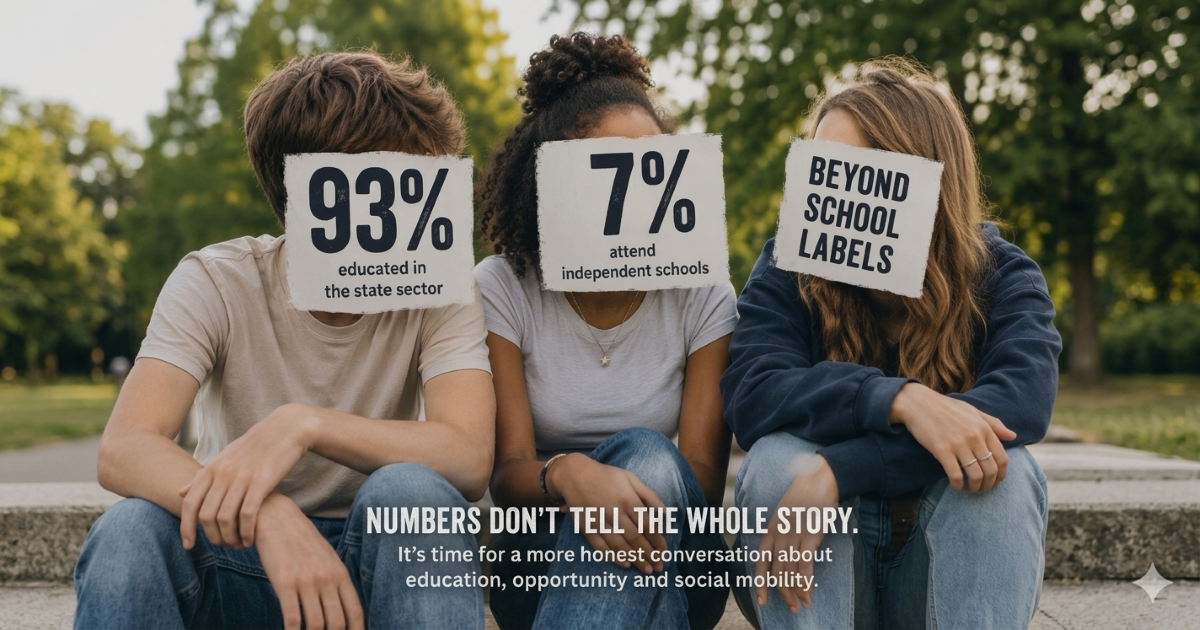
93% of children are educated in the state sector, while just 7% attend independent schools.
While independent schools have educated a relatively small proportion of pupils for decades, the now-familiar “7% versus 93%” framing became particularly prominent during the 2000s and 2010s as social mobility research and widening participation agendas expanded.
Studies highlighting the overrepresentation of privately educated individuals in elite professions helped transform the statistic from a simple participation figure into one of the defining narratives of modern education debate.
Organisations such as The Sutton Trust and later The 93% Club, helped embed the framing within public discourse, often using comparisons between the “7%” and the proportion of privately educated individuals going on to University and occupying influential professional roles.
Over time, the statistic evolved into something much broader than a school participation measure. It became a symbolic narrative about privilege, fairness and representation, increasingly shaping political debate, media coverage and public perceptions of children themselves.
Part of the reason the “7% versus 93%” framing became so influential is that it reduced a highly complex educational and social ecosystem into a morally intuitive binary.
It offered a simple and emotionally compelling story:
- a small, privileged minority
- and a larger, comparatively disadvantaged majority.
That simplicity made the narrative powerful and easy to communicate.
But simplicity and accuracy are not always the same thing.
The danger is that once a complex reality is reduced to binary labels, nuance begins to disappear, along with recognition of the many different forms of both advantage and disadvantage that exist across the entire education system.
Increasingly, school labels are being used as a blunt proxy for social background, opportunity and disadvantage, despite the reality being far more complex.
This article takes a closer look at the now deeply embedded “7% versus 93%” framing, questioning not whether disparities exist, but whether the categories themselves are as meaningful and reliable as public and policy debate often assumes.
The “7%” Is Not a Tiny Voice
At the same time, the “7%” figure itself can create a misleading impression of insignificance or marginality.
Even if we accept the figure as broadly plausible for current school attendance, it does not remotely capture the wider number of people in Britain who believe in, value, support or have benefited from independent schooling at some point in their lives.
Our analysis suggests there are approximately:
- 9 million adults in the UK who have attended an independent school at some stage of their education.
When we also consider:
- around 580,000 current independent school pupils
- their parents and carers
- step-parents
- grandparents and wider relatives
- and the many families who make major financial sacrifices to access independent education
the potential community of individuals who actively support independent schooling as part of the UK’s diverse education system is likely to be closer to 10 million people.
That is not a tiny fringe minority.
And many of these families share characteristics strongly associated with educational success and social mobility:
- high levels of parental engagement
- belief in the value of education
- aspiration for their children
- willingness to invest time, energy and resources into schooling.
Their voices matter too.
Not All Independent Schools Are the Same
None of this is to deny that some independent schools are exceptionally privileged institutions with powerful historical networks and significant advantages.
The question is whether those institutions can fairly be treated as representative of all independently educated children and families.
There are approximately 2,500 independent schools across the UK. The majority (over 70%) are relatively small schools with fewer than 300 pupils.
Many are:
- rural community schools
- faith schools
- specialist SEND schools
- or schools fulfilling important local needs where state provision is not be suitable for every child or family.
None of this means inequality does not exist.
But the archetypes of Eton College, Harrow School and Winchester College et al are not necessarily representative of the remaining 2,490 ish independent schools educating children across Britain today.
If we want serious, evidence-led conversations about social mobility, we need to examine whether the simplistic “7% versus 93%” framing is helping us understand the problem properly, or whether an over-reliance on this number is obscuring the much more complex realities that actually shape educational outcomes and life chances.
How the “7%” Statistic Is Used
The Sutton Trust has repeatedly highlighted the presence of privately educated individuals among senior judges, politicians, journalists, diplomats, medics, military leaders and business leaders. Groups such as The 93% Club* have built entire campaigns and identities around the idea that a small, privileged “7%” continues to dominate elite pathways. (See footnote for more info on The 93% Club).
These findings are important and deserve serious consideration.
But there is also an important question that is rarely explored publicly:
What exactly are these statistics measuring?
And perhaps more importantly:
Are we drawing conclusions from comparisons that are not actually like-for-like?
Where Does the “7%” Come From?
The “7%” figure is generally derived from annual school census data showing the proportion of pupils currently attending independent schools at a single point in time.
In other words:
It is a snapshot.
But when young people are described as “privately educated” for university admissions, work experience and other opportunities and, similarly, as adults in studies of elite professions, the definition is often far broader.
That can include people who:
- attended an independent school briefly
- moved between sectors
- attended private sixth form only
- were privately educated for only part of their schooling journey
This matters enormously.
Because the public debate frequently compares:
- a narrow point-in-time school attendance figure
with:
- a broad lifetime educational category
That is not a clean comparison.
Which “Side” Are Mixed-Education Pupils Counted On?
Large numbers of children move between sectors during their education:
- state primary → private secondary
- private prep → state grammar
- state secondary → private sixth form
- private junior → state sixth form college
So which category do they belong to?
There is no universally consistent answer.
Many adult datasets classify someone as “privately educated” if they attended an independent school at any point, even if most of their education took place in the state sector.
Yet the headline “7%” figure refers only to current attendance at one moment in time.
This creates a fundamental inconsistency:
The same individual may contribute to the “7%” narrative in adulthood despite spending most of their education within the “93%”.
The “93%” Is Not a Single Group
The opposite side of the comparison is equally problematic.
The “93%” is often treated as a single, less advantaged majority. But it is not a coherent category at all.
Within the state sector alone there exists enormous variation:
- selective grammar schools
- affluent catchment comprehensives
- socially selective faith schools
- elite sixth-form colleges
- high-performing academies
- schools in severe deprivation
- alternative provision settings
Because the state sector educates the overwhelming majority of children, it also contains the majority of advantaged families, highly engaged parents and high-attaining pupils.
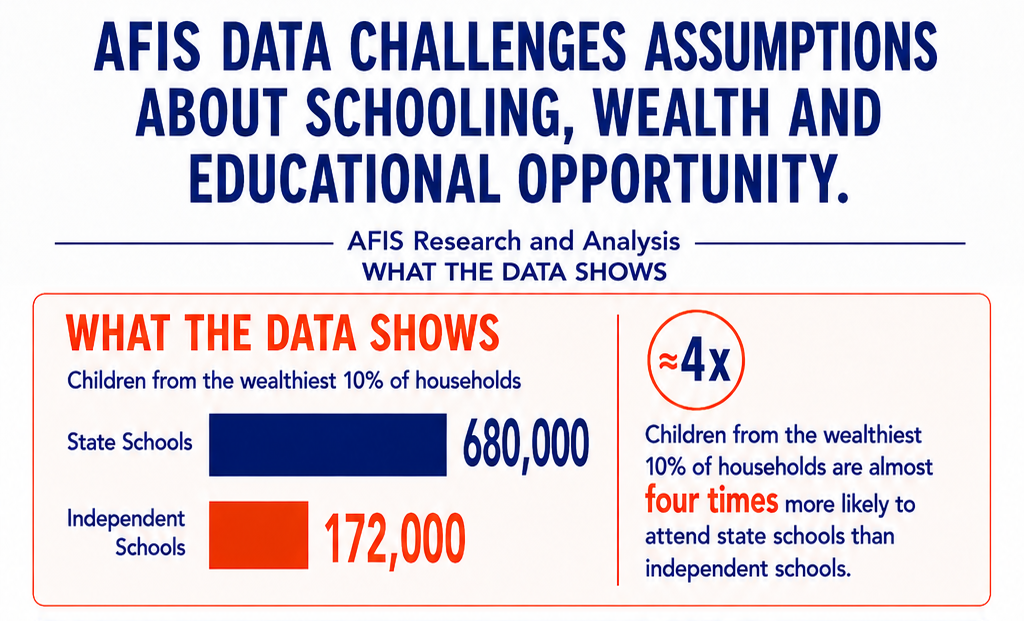
AFIS analysis drawing on UK household income distribution data suggests there are likely to be around four times as many children from top-income households educated within the state sector as within the independent sector.
In fact, the number of pupils from affluent households educated in the state sector likely exceeds the entire current population of UK independent school pupils.
This is one of the central weaknesses of the simplistic binary framing:
it treats the “93%” as though it were broadly homogeneous and comparatively disadvantaged, when in reality it contains enormous concentrations of both advantage and disadvantage.
Independent schools may concentrate and amplify certain advantages, but they do not create all of the underlying drivers of educational success.
Family background, parental engagement, expectations, early attainment, peer environment, guidance and preparation all interact in complex ways throughout a child’s educational journey.
Educational outcomes emerge through a long “pipeline” shaped by family background, early attainment, guidance, preparation, networks and opportunity, not simply the choice of “2 school types”.
Correlation Is Not the Same as Causation
The public debate often moves very quickly from:
privately educated people are overrepresented in elite professions
to:
private schooling itself must therefore be the primary cause.
But this may confuse correlation with causation.
What the Sutton Trust and 93% Club Comparisons May Miss
Reports from The Sutton Trust frequently compare the proportion of privately educated people in elite professions against the “7%” figure.
The 93% Club* similarly frames its mission around the idea that a disadvantaged “93%” is underrepresented in elite institutions because of the advantages enjoyed by the “7%”.
But these comparisons often overlook several important issues:
- inconsistent definitions
- historical cohort effects
- selection effects
- and the large number of advantaged pupils educated within the state sector itself.
This does not mean the overrepresentation findings are false.
But it does mean:
the comparisons are not isolating the effect of school type alone.
When Simplistic Labels Shape Real Decisions
The growing use of these binary school categories as a proxy for disadvantage is no longer confined to political rhetoric or media debate.
Increasingly, it is shaping:
- access to opportunities
- pricing structures
- outreach initiatives
- and public perceptions of children themselves.
Examples increasingly include:
- differential pricing for arts and cultural programmes
- outreach and work experience opportunities restricted by school type
- media crime reporting that routinely highlights “private school” backgrounds
- persistent stereotyping of pupils and families across the education sector.
The concern is not that disadvantage should not be addressed.
It absolutely should.
The concern is whether simplistic school labels are becoming a substitute for properly identifying need, disadvantage and opportunity.
Children Rarely Chose Their Schools
Perhaps the most uncomfortable aspect of this entire debate is that children themselves rarely choose which schools they attend.
Schooling decisions are usually made by parents and carers, influenced by a complex mixture of:
- geography
- affordability
- family circumstances
- educational needs
- local provision
- values and aspirations.
Yet increasingly, children are the ones being labelled, profiled and categorised according to the sector they happen to attend. And the school label often sticks to them, for life.
That should concern us all.
Because children should not become symbolic proxies in a wider culture war about class, privilege and inequality.
What is often missing from these discussions is a recognition that all children, regardless of the type of school they happened to attend, deserve:
- dignity
- fairness
- nuance
- and the opportunity to be judged as individuals rather than stereotypes.
The Responsibility of the Adults in the Room
Surely it is the responsibility of the adults in the room to:
- examine the evidence carefully
- question simplistic assumptions
- avoid tribalism and division
- and build a system that genuinely improves opportunity for all children.
Because the stakes extend far beyond schooling itself.
They affect:
- social cohesion
- national prosperity
- public trust
- and whether future generations inherit a more tolerant and less antagonistic society.
These concerns sit at the heart of AFIS’s emerging work around:
Rethinking Social Mobility; Beyond School Labels
The principle that children and adults should not be judged simply because of the type of school they attend or attended.
Moving Beyond Binary Labels
The real divide is not simply “93% versus 7%”.
It is:
advantage versus disadvantage, across the entire system.
And all children deserve better than to be reduced to simplistic labels and assumptions.
If you believe that children should not be categorised, profiled and treated differently just because of the type of school they attend, SIGN OUR PETITION HERE and be part of the SOLUTION and the call for positive change, being led by AFIS.
Footnote* If you are not familiar with The 93% club, it’s well worth a look. This charity (with a limited company trading arm) was set up in Bristol 10 years ago and is now a very successful national organisation.
The 93% Club
They have about 32,000 members and are represented in 51 universities around the country.
They promote and facilitate what some people consider to be “positive discrimination” in favour of state-educated students.
They describe themselves as “The UK’s largest network of state-educated people”, and say:
Despite making up 93% of the UK population, state-educated people are vastly underrepresented in virtually every top institution, with private school alumni making up 65% of FTSE 350 CEOs, 57% of Peers, 52% of diplomats, 44% of columnists, 46% of corporate lawyers, and 59% of permanent secretaries.
This disparity is driven by the exclusive networks private schools provide, offering lifelong opportunities and connections that state school students often lack. That's why we're building the UK's least exclusive members' club.
Our mission is simple: to give state-educated people the same access to powerful connections, knowledge, and opportunities that have historically been reserved for the privately-educated.
With over 32,000 members and growing, we’re transforming what it means to be state-educated – from the classroom to the boardroom.