Click HERE to engage with AFIS on Linkedin
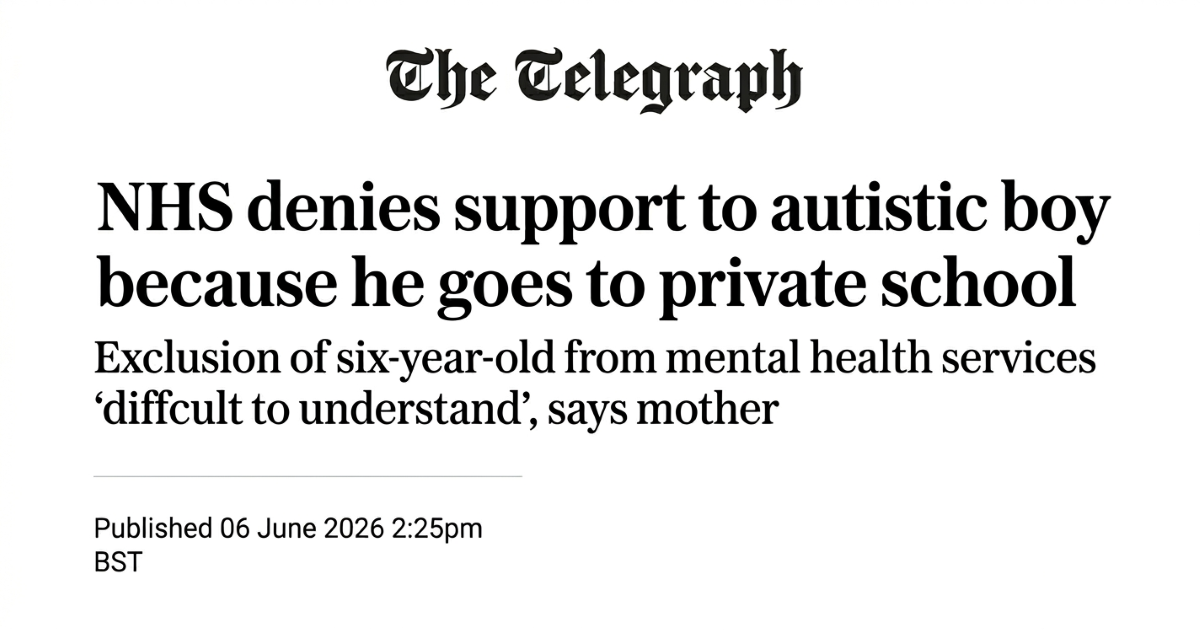
Child denied access to NHS service because of the school he attends.
This is not an isolated incident.
Today, The Telegraph has published the story of one AFIS member and her son, who was denied support through the local NHS Child and Adolescent Mental Health Service because he attends an independent school.
A child being denied access to public services because of the type of school they attend should concern everyone.
This should not be about school type.
It should not be a political issue.
It is a child welfare issue.
We are extremely grateful to this parent, and to all our members who trust the Association For Families Of Independent Schooling (AFIS) C.I.C. with their personal stories and concerns.
Many of these stories are sensitive and distressing. Yet our members continue to come forward because they believe these issues deserve wider public attention and because they want AFIS to coordinate a serious, evidence-led campaign for change.
One of the important roles AFIS plays is providing families with a trusted and professional route to ensure their concerns are heard by journalists, MPs, policymakers and other decision-makers, while retaining control over their privacy and anonymity.
We recognise that many parents do not wish to put themselves or their children in the public spotlight.
AFIS launched its 𝗕𝗘𝗬𝗢𝗡𝗗 𝗦𝗖𝗛𝗢𝗢𝗟 𝗟𝗔𝗕𝗘𝗟𝗦 campaign because we wanted to do something constructive about the growing number of incidents where children and young people are excluded from opportunities, disadvantaged by policies or denied access to services because of assumptions and stereotypes attached to the type of school their parents chose for them.
The Telegraph article highlights one such case.
AFIS has documented many more.
Individually, they tell the story of one child or one family.
Collectively, they reveal a much wider problem.
School type is increasingly being used as a proxy for need, disadvantage and entitlement, and as a filtering criterion for access to support, opportunities and public services.
That is wrong.
Support should be targeted according to actual need, not assumptions.
Children’s needs should be assessed according to their individual circumstances, not labels and stereotypes attached to the type of school they attend.
That is why AFIS launched its 𝗕𝗘𝗬𝗢𝗡𝗗 𝗦𝗖𝗛𝗢𝗢𝗟 𝗟𝗔𝗕𝗘𝗟𝗦 campaign and petition, and why we will shortly publish our Rethinking Social Mobility Through Schooling report, examining these issues in greater depth and proposing practical, evidence-led solutions.
We are engaging with policymakers, academics, researchers, think tanks and other stakeholders.
We welcome constructive dialogue from anyone interested in helping us better understand these challenges and develop practical solutions that work better for all children and families.