Click HERE to engage with AFIS on Linkedin
Tom Richmond, Education Policy Analysts reports:
"Supporters of #VAT on private school fees have repeatedly dismissed claims that the policy was hurting the #privateschool sector. My new analysis shows that those supporters are wrong.
Over the last year or so, we've had government spokespeople describe independent school closures as a "manufactured crisis" and claim that independent schools are "evidently in rude health, despite the fearmongering of the private schools lobby and their Tory MP lackeys."
Such dismissals have often been linked to the fact that after VAT was added to fees in January 2025, 107 new #independentschools opened last year but only 71 closed. That is true.
71 was also smack-bang on the long-term historical average for the number of independent schools that have closed each year over the last two decades.
So, VAT on fees had no effect on private schools, right?
Hold on a moment.
Looking at the *number* of schools that have closed since January 2025 is pretty much irrelevant. What we need to know is the *size* of the schools that closed because, at the risk of stating the obvious, 5 schools closing with 5 pupils each is a completely different scenario to 5 schools closing with 500 pupils each.
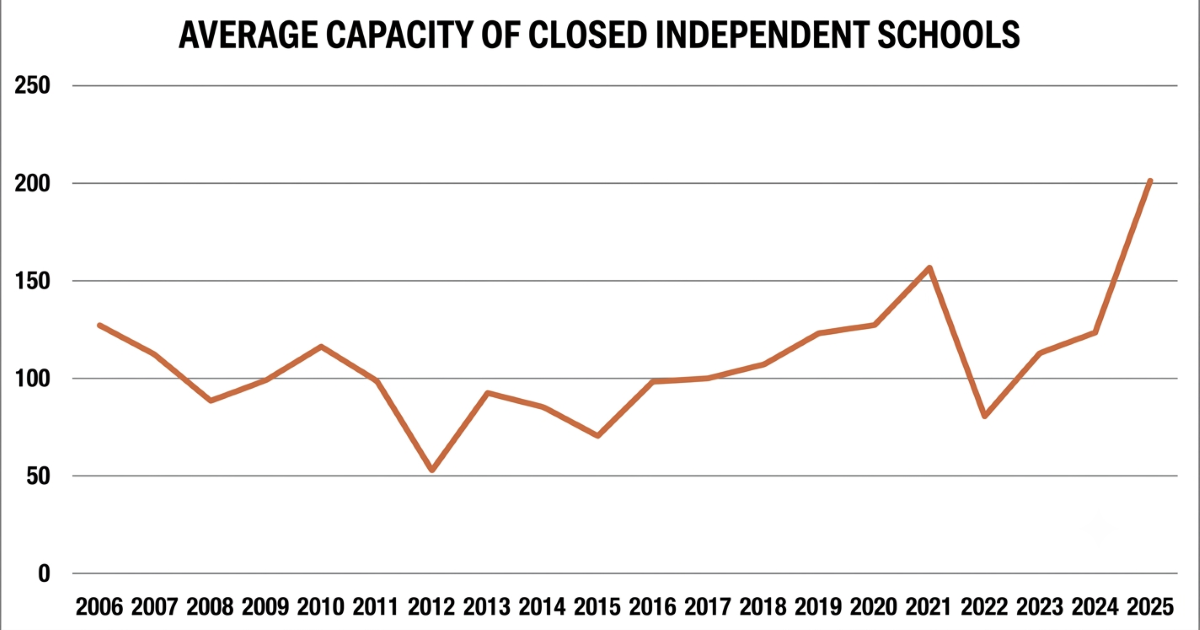
As my new analysis in The Times today shows (link in the comments), when looking at the size of schools that closed in 2025, last year saw an unprecedented collapse in larger independent schools.
The average capacity of the independent schools that closed last year was 201 pupils - that's almost double the average over the last 20 years (108 pupils) and 63% higher than in 2024 (123 pupils).
Since comparable records began, we have *never* seen large independent schools close on this scale - not even during the pandemic.
I think my graph below (based solely on the Government's school database) sends a very clear message: claiming that 2025 was a normal year for independent schools, or that VAT on fees has had no discernible effect, or that independent schools are financially in 'rude health', is just plain wrong.
In a few days from now, we will see the new data on pupil numbers from the January 2026 school census for both the state and independent sectors.
My analysis suggests that the Government may have badly underestimated the impact that VAT on fees would have on independent schools, for which taxpayers could pick up a very significant tab.
Just as I've done in The Times today, we should let the data tell the story - not politicians or press officers."
AFIS Founder, Michelle Daniells responds:
In the Aftermath of VAT, The Number of School Closures Is Just One Part of the Story
For more than a year, much of the debate around VAT on independent school fees has been framed around a simple question: How many schools have closed?
As Tom Richmond's analysis highlights, the number of closures is not the only thing that matters. The size of the schools affected matters too.
But even that is only part of the picture.
AFIS would add that the location of those schools matters as well. Many are located in London and the South East, where independent-school participation is highest and where displaced pupils are most likely to create localised pressure on neighbouring schools, colleges and admissions systems.
This is why AFIS has repeatedly argued that impacts must be monitored locally, not simply through national averages.
Over recent months, AFIS has gathered evidence suggesting pressures may already be emerging at key transition points, particularly in post-16 education. In one example examined by AFIS, applications for the 2025/26 academic year increased by 22%, while almost nine in ten applicants placed on the waiting list ultimately failed to secure a place.
Families have also reported refusals, shrinking catchment areas, long waiting lists and prolonged uncertainty.
Yet there is currently no comprehensive national system monitoring trends in oversubscription levels, waiting-list outcomes or unsuccessful applications across the whole state sector,
That raises two important questions: is Government measuring the right things, in the right places, to understand the full impact of these changes? (We think the answer to that is NO). And where evidence of pressures and problems does exist, what action is being taken to respond?
This debate has never been solely about school buildings or balance sheets.
Children experience these changes through disrupted education, uncertainty, longer journeys and lost friendships. Families experience them through difficult decisions and financial strain. Teachers and support staff experience them through concerns about jobs and livelihoods. Local communities lose schools that often serve as employers, community hubs and contributors to local economic life.
As more data emerges, the focus should not be on proving who was right or wrong. It should be on understanding what is happening, where pressures are emerging and how policy should adapt in response.
The challenge for policymakers is not simply to measure impact, but to respond to it.
That is why AFIS continues to gather evidence directly from families, schools and communities, and why our forthcoming White Paper will explore the wider educational, social and economic consequences of recent policy changes.