Click HERE to engage with AFIS on Linkedin
In modern Britain, few issues have become as emotionally charged, tribalised and politically symbolic as schooling.
What should fundamentally be a child-centred conversation about learning, opportunity, development and human flourishing has increasingly become a battleground for wider ideological debates about class, privilege, fairness and identity.
And in that process, children themselves risk becoming secondary to the politics surrounding them.
At AFIS, we believe it is time to ask a difficult but important question:
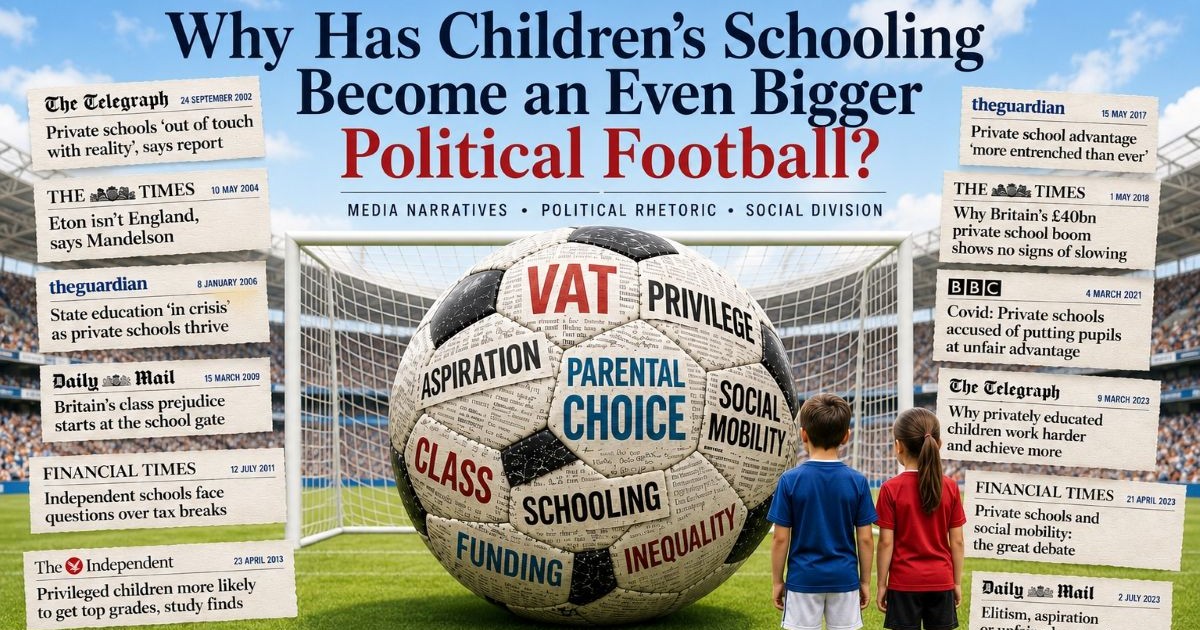
Has schooling become a political football?
When Education Becomes Symbolic
The debate around schooling in the UK has increasingly moved beyond practical questions such as:
- What helps children thrive?
- What kinds of school cultures produce positive outcomes?
- How can we improve teaching quality?
- How do we support disadvantaged children effectively?
- What role do parents and families play?
Instead, schooling has increasingly become symbolic.
Particular types of schools are often used as shorthand for broader political narratives:
- privilege
- inequality
- aspiration
- elitism
- social division
- or even morality itself.
This is especially true in debates around independent schools.
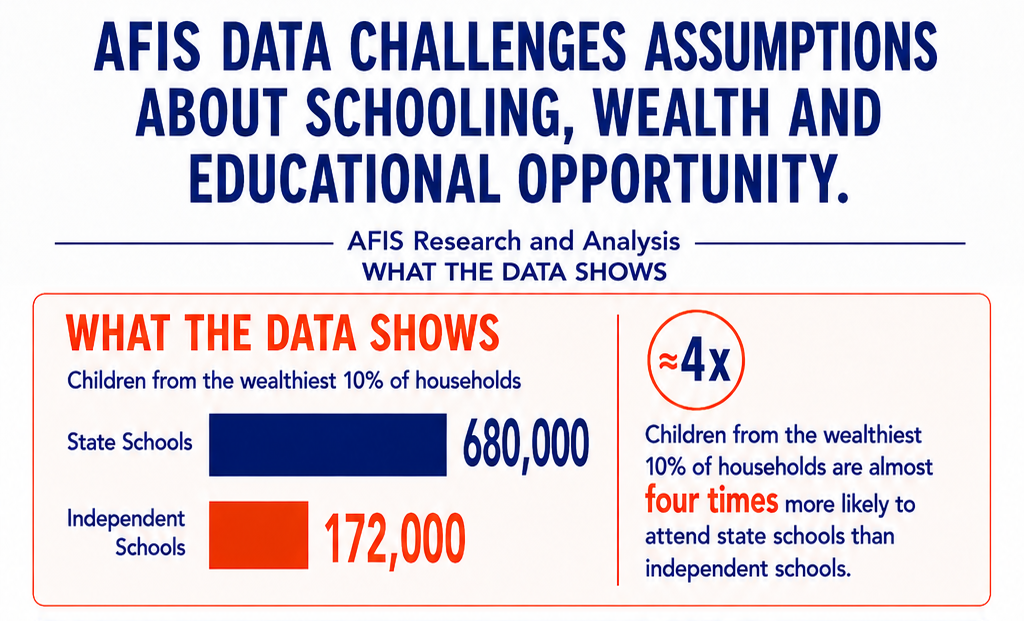
The existence of fee-paying schools has become one of the most politically charged issues in public life, despite the fact that only around 7% of UK children attend them.
Meanwhile, the remaining 93% of children in state education are often discussed as though they form one homogenous group, despite enormous differences in:
- family income
- parental education
- cultural capital
- school quality
- geography
- social environment
- and opportunity.
The resulting narratives are often highly simplistic.
And simplistic narratives rarely lead to good policy.
Children Are Not Political Labels
One of the most concerning trends in modern education debate is the increasing tendency to define children primarily by institutional labels:
- “private school child”
- “state school child”
- “grammar school child”
- “disadvantaged pupil”
- “working class student”
- “elite”
- “privileged”
- “ordinary”.
Yet no child can be meaningfully understood through a single category.
A child attending an independent school on a means-tested bursary may have very little in common economically with a billionaire’s child at a globally famous boarding school.
A child at a high-performing state comprehensive in an affluent catchment area may possess enormous cultural, educational and financial advantages compared with a child growing up in deep deprivation elsewhere.
And yet public debate often collapses these complexities into crude binaries.
Children become proxies for wider political arguments.
But children are not political labels, statistical proxies or ideological talking points.
They are individuals with complex lives, family dynamics, strengths, vulnerabilities and aspirations.
The Rise of Binary Thinking
Much of modern political discourse rewards simplification.
Complex realities are reduced into:
- oppressor vs oppressed
- advantaged vs disadvantaged
- privileged vs excluded
- state vs private.
This framing may be emotionally powerful, but it often obscures more than it reveals.
Schooling outcomes are shaped by a deeply interconnected ecosystem of influences:
- parental engagement
- educational expectations
- peer environments
- school culture
- housing and geography
- family stability
- access to enrichment
- confidence and communication skills
- professional networks
- mental health and wellbeing
- and wider community norms.
Reducing all of this to “school type” alone risks fundamentally misunderstanding what drives educational outcomes.
And once flawed assumptions become politically embedded, they can begin driving policy itself.
When Schooling Becomes Electoral Strategy
Perhaps nowhere is the politicisation of schooling more visible than during election cycles.
Education policy increasingly becomes a tool for signalling ideological identity:
- taxing private schools
- removing charitable status
- restricting access initiatives
- “cracking down on privilege”
- or using schooling background as shorthand for fairness debates.
The problem is not that education policy should be immune from scrutiny or reform.
The problem is when complex educational realities become reduced to emotionally satisfying political symbolism.
Once that happens, the risk is that policies are designed:
- not primarily to improve outcomes for children,
but: - to communicate political positioning.
In this environment, nuance becomes difficult.
Questioning simplistic narratives can itself become politically controversial.
The Danger of Division
There is also a wider social cost.
Britain already faces growing fragmentation:
- political polarisation
- declining trust
- identity-based division
- and increasing hostility between different social groups.
Schooling debates can unintentionally deepen these fractures.
Parents who make different educational choices are increasingly encouraged to view one another through lenses of suspicion:
- privileged
- elitist
- irresponsible
- anti-social
- selfish
- or ideologically suspect.
This is deeply unhealthy.
Most parents — regardless of sector — are trying to do what they believe is best for their children.
Most teachers — regardless of sector — care deeply about young people and their futures.
Most children themselves are entirely innocent participants in systems and debates they did not create.
And yet public discourse increasingly encourages division rather than understanding.
A Better Conversation
At AFIS, we believe Britain needs a more balanced, evidence-led and child-focused conversation about schooling.
That means moving:
- beyond slogans
- beyond stereotypes
- beyond simplistic labels
- and beyond tribal political framing.
It means recognising that educational success and opportunity are shaped by many overlapping factors, not simply by the category of school a child attends.
It means understanding that disadvantage exists across all sectors — just as advantage does.
It means designing social mobility policies that are carefully targeted towards genuine need, rather than relying on increasingly blunt assumptions and proxies.
And it means accepting that good schools, strong teaching, ambitious cultures and engaged families should be encouraged wherever they are found.
Schooling Shouldn’t Be a Political Football
Children only get one childhood.
Their education should not become collateral damage in wider ideological battles.
The future of the country depends on creating an education system that is:
- ambitious
- fair
- inclusive
- evidence-led
- and focused relentlessly on helping every child flourish.
That requires mature debate rather than tribal politics.
It requires curiosity rather than caricature.
And above all, it requires us to stop reducing children to labels.
Schooling should not be a political football.
Beyond labels. Focused on children.