I recently spoke with a consultant who works with independent schools in the UK. When I mentioned I worked with the Association For Families Of Independent Schooling (AFIS) C.I.C., they said:
“Oh yes, I’ve heard of you, you’re all about VAT on school fees and organised that anti-VAT petition and Facebook group.”
“No,” I replied. “We had no involvement in any of that. That was the Education Not Taxation campaign group (ENT). AFIS has no connection with that group.”
It’s not the first time this confusion has been mentioned to me and it feels important to set the record straight.
AFIS is not associated with the Education Not Taxation (ENT) campaign
The Education Not Taxation (ENT) campaign group describes itself as:
“Parents Against School Fee VAT”.
That is their campaign.
It is not AFIS.
AFIS has no organisational, strategic, or operational connection with the ENT campaign group.
AFIS was not created in response to VAT
While the introduction of VAT on school fees generated intense public debate, particularly on social media, AFIS was not formed as a reaction to this single policy issue, nor as a short-term campaign.
AFIS is a formal, not-for-profit Community Interest Company (CIC) with a long-term, sustainable purpose.
Our early feasibility and market research confirmed a clear gap:
There was no professional association representing families who opt for independent education, despite those families being widely discussed, judged, and stereotyped.
So we decided to respond constructively by creating one.
Why AFIS exists
AFIS was created to address two enduring challenges;
1. Misrepresentation of independent school families
Public debate around independent education is increasingly shaped by:
- crude wealth assumptions
- oversimplified narratives
- limited or absent data
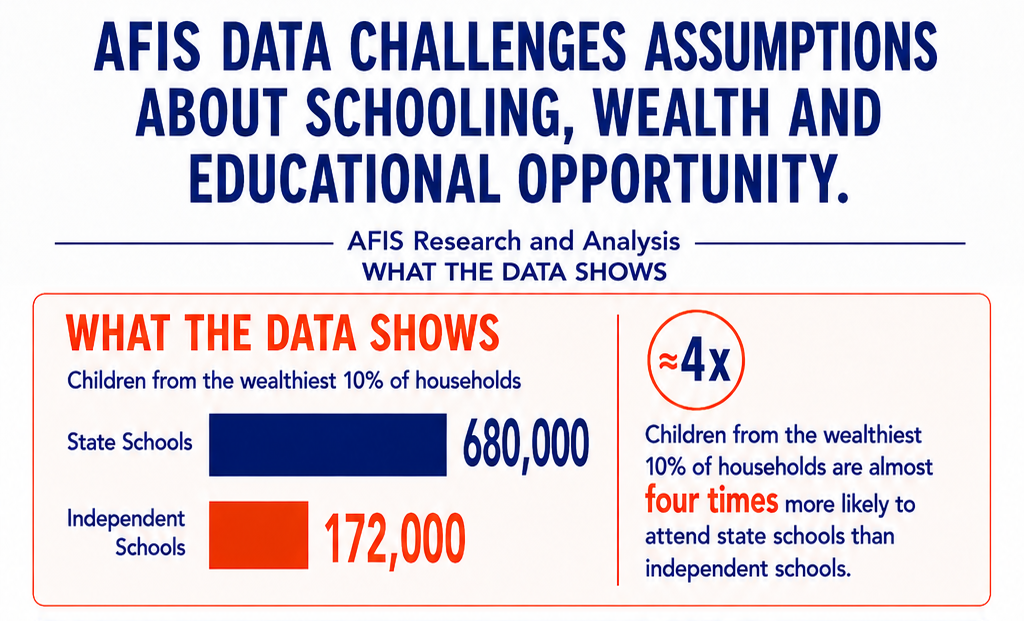
Families who choose independent education come from diverse backgrounds, with varied motivations, including SEND needs, gaps in local provision, philosophical, religious or pastoral fit, and individual children’s needs.
AFIS exists to:
- bring parents together in a credible, coordinated way
- translate lived experience into robust, evidence-led insight
- support informed national discussion, rather than polarised debate
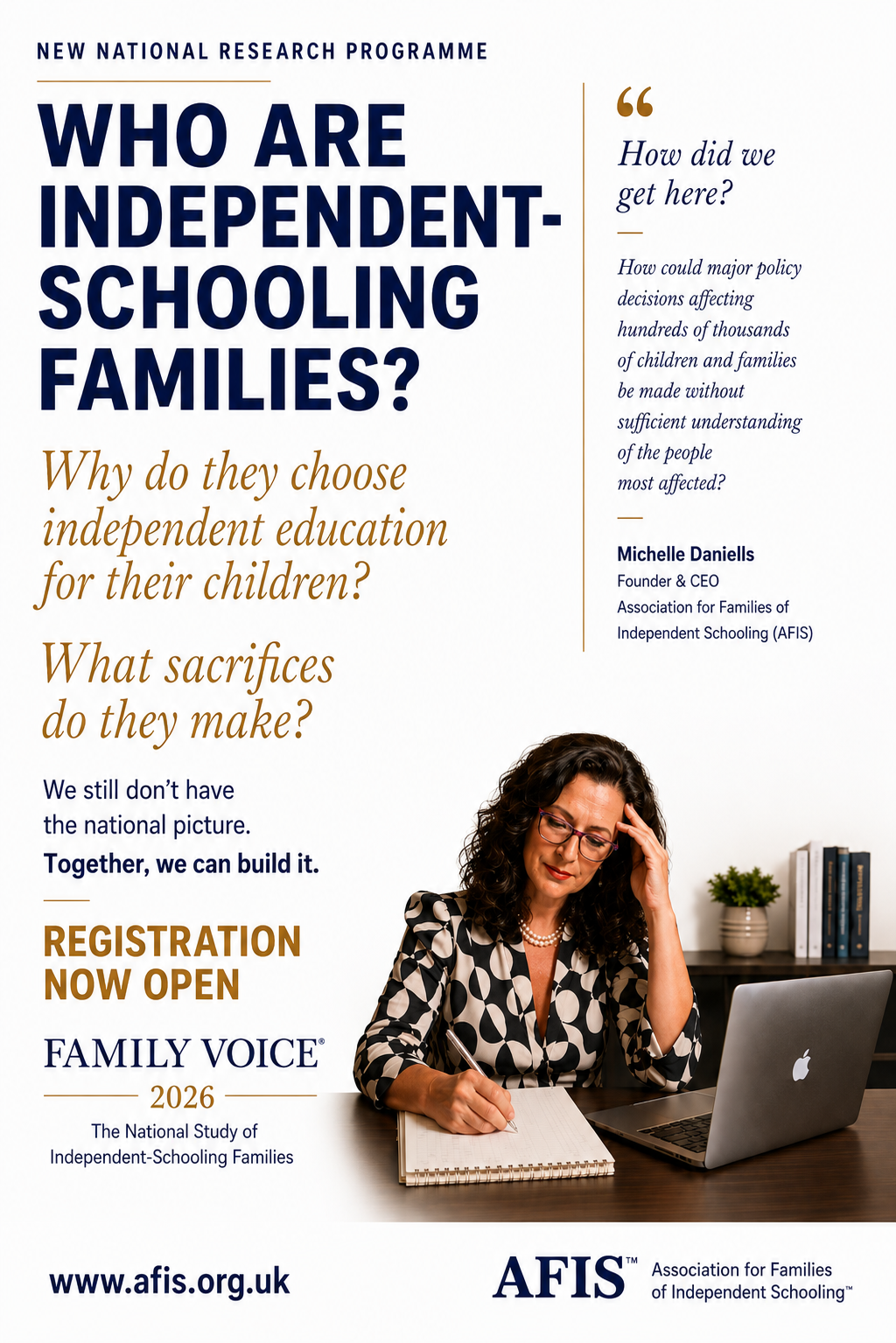
Our first major independent research project, facilitated by the University of Chichester, will begin in early 2026, focusing on:
- What is the demographic profile of families who opt for independent schooling?
and
- Why do they choose independent education for their children?
2. Rising financial pressure on families
Independent education is becoming increasingly fragile for many families, with real consequences for children’s stability and wellbeing. It is also becoming more out of reach for many hard-working families who would actively choose independent education if it were affordable to them. Polling suggests that around four in ten adults in Great Britain say they would send their child to a private school if cost were not a barrier (YouGov, June 2024).
As costs rise, increasing numbers of families face acute financial pressure, with some at risk of having to withdraw children from schools where they are settled and thriving.
With the support of our members, AFIS is establishing:
- a school fees top-up fund to help support children at risk of having to leave the independent schools they know and love due to financial pressure on their families; and
- a widening access fund to support bursaries and help more families to access independent schooling.
Why AFIS™ is needed now more than ever
The independent education landscape is changing:
- Public debate around independent education has become increasingly polarised and adversarial
- Families who choose independent schooling face growing stigmatisation, driven by outdated and often crude assumptions about wealth and privilege
- Rising costs mean fewer families are able to access independent education
- Financial pressure is forcing many schools to reduce the level of means-tested fee assistance they can offer
- An increasing number of independent schools are closing due to mounting financial challenges
These shifts have created a clear need for:
- stronger, independent research
- credible representation of families’ lived experiences
- new, practical ways to support both families and schools
When we spoke with parents across a wide range of independent schools, many said they wished an organisation like AFIS™ had existed years ago:
“If only we had something like this to advocate for us before the recent VAT issue.”
Better late than never; the need remains urgent and AFIS is here now, not only to respond to current pressures, but to help families and the sector prepare for future challenges.
Why a more balanced debate matters
The public debate around private schooling has become increasingly polarised, divisive and adversarial.
When discussions about education are reduced to opposing camps, children and families are poorly served, and opportunities for thoughtful, constructive solutions are lost.
As AFIS™ Consultant Research Adviser Dr Steven Watson, Associate Professor, University of Cambridge, spells out: “The public debate about independent schooling in the UK has become increasingly polarised. On one side, there are claims of privilege, inequality, and social stratification. On the other, there are defences of choice, quality, and contribution to public life. But what’s often missing from this discussion – across media commentary, political rhetoric, and even some research – is balance, rigour, and inclusivity. Much of the existing data is partial, the framing often one-sided, and the voices of families who actually choose independent education rarely heard.”
Dr Watson continues: “As an academic researcher with a background in education and systems theory, I believe one of the most constructive things we can do is to improve the quality and integrity of the data that informs this debate. This doesn’t mean advocating for or against private education per se. It means committing to the basic principle that if we are to talk about the role of independent schools in our society, we should do so with evidence that is methodologically sound, inclusive in scope, and capable of capturing the diversity of what private schooling really looks like in the UK today.”
AFIS recognises that concerns about fairness, access, and inequality in education are legitimate and important. These issues deserve serious, evidence-led discussion, not slogans, assumptions, or hostility.
At the same time, AFIS does not believe progress is made by pitting independent schools against state schools, or by framing parents’ choices as moral or political statements.
We are conscious that efforts to promote balance and collaboration can sometimes be misinterpreted as defending a sector or minimising inequality; that is not our purpose.
We want all schools and children to thrive, and we recognise that different parts of the education system face different challenges.
Every parent wants the best possible education for their children, within the constraints and realities they face. Families make different choices for many reasons:
- children’s individual needs or vulnerabilities
- local availability and quality of state provision
- pastoral fit, safety, or specialist support
- practical considerations such as location, work, and family circumstance
These decisions are rarely ideological. They are pragmatic, often difficult, and deeply child-centred.
What unites families is far greater than what divides them.
Everyone wants more good schools, stronger outcomes, and fairer opportunity for all children.
Building bridges, not defending silos
AFIS is not seeking to defend a sector, protect privilege, or minimise the challenges facing state education.
Our focus is on families’ lived experiences, children’s educational continuity, and constructive contribution to the wider education conversation.
That means building bridges, sharing evidence, listening across differences, and working towards a system that serves all children, whatever school they attend.
From online debate to meaningful representation
The VAT debate exposed something important:
in the absence of a national association, thousands of parents turned to social media to share experiences and views.
Much of that contribution was thoughtful and constructive, but it was:
- fragmented
- easily drowned out by extreme voices
- rarely translated into credible evidence or policy engagement
AFIS exists to move beyond that.
We bring parents and all supporters of independent schooling together to:
- elevate lived experience
- produce credible research
- and contribute constructively to public and policy discussion
AFIS is not an anti-VAT campaign group.
AFIS is a formalised community platform championing parental choice, accessibility, and fair representation for families in independent education.