Click HERE to engage with AFIS on Linkedin
John Russo reports:
The trouble with aiming a tax at the privileged is that the privileged never feel it.
That's the quiet scandal of the VAT raid on independent schools. It was sold as a blow against advantage. So let's be precise about where the blow actually landed, because it wasn't on the UHNW parents. They are fine.
They paid the 20%, shrugged, and carried on.
The people who couldn't shrug were the ones the policy was never supposed to touch: the parents who were already at the edge of what they could afford, working a second job, going without, because they'd decided this particular school was worth the sacrifice.
So they were the first to break.
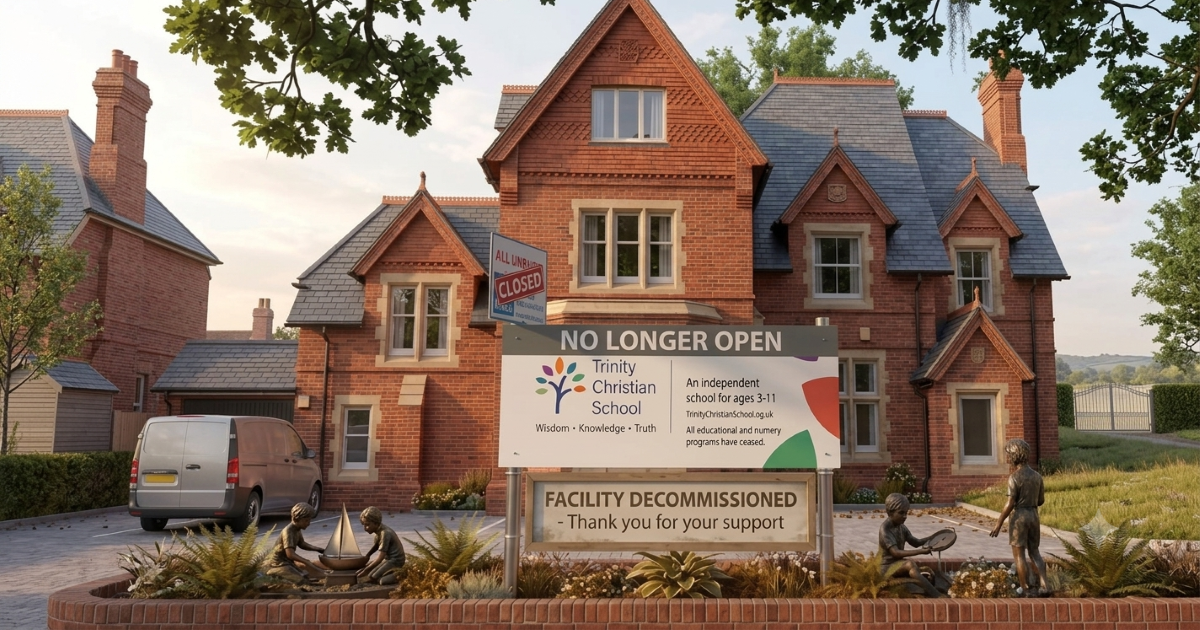
And the schools that broke with them weren't the famous ones. It was the fifty-pupil prep founded by somebody's mother in Devon. The small place that took the child, no mainstream school could settle. The cathedral choir school that had been teaching children since 1179, until the Treasury decided eight centuries was long enough.
Here's what genuinely offends me about it.
This was not a hard problem to foresee. You didn't need a sophisticated model. You needed a calculator and ten minutes of honesty. Put a sudden 20% on any service, and the wealthy absorb it while the stretched walk away. Something the Independent Schools Council tried to warn. But the people who designed this policy aren't stupid.
Which leaves only one explanation.
They knew the marginal families would be hit hardest, and they decided the symbolism was worth more than the children. The point was never really the revenue, or the teachers. The point was to be seen doing it.
That's the bit a serious person can't forgive. Not the error. The choice.
Because the trade we were promised has not arrived. More children have left the sector than the government forecast for its first year. The families leaving are disproportionately the ones who were already straining. They taxed real schools out of existence to pay for a headline, and the headline didn't even hold.
And the army of new teachers this was all meant to fund has proven, to put it gently, difficult to locate, as recent parliamentary answers and analysis shared by people like Dan Neidle and James Quarmby have made painfully clear.
A decision is not judged by how righteous it feels. It’s judged by what it does in the world. And what this one has done is take a sector that was already squeezed by demography and finish the job, then present the funeral as a policy success. Scotland has already shown, in miniature, what happens when you ignore that dynamic. England is just running the same script on a bigger stage
The policy aimed for the yacht but sank the rowing boats, and then called it a fairer sea.
Excellent commentary in The Spectator on this very topic - https://lnkd.in/emhJ2Jts
AFIS Founder, Michelle Daniells responds:
Thank you John Russo for this powerful reflection about the flawed thinking that led to #VATonschoolfees.
The Association For Families Of Independent Schooling (AFIS) C.I.C. continues to gather evidence of families priced out, disruption to children’s education, school closures and increasing pressure on state provision.
While much has been said about the consequences of VAT, AFIS is also asking different, critical questions, to help drive lasting change:
𝗛𝗼𝘄 𝗱𝗶𝗱 𝘄𝗲 𝗴𝗲𝘁 𝗵𝗲𝗿𝗲?
How did a policy affecting hundreds of thousands of children and ordinary families come to be presented as a righteous blow against privilege?
For far too long, public understanding of independent schooling has been shaped by stereotypes, assumptions, media and political spin.
People saw schools such as Eton, Harrow and Westminster; straw boaters and tailcoats.
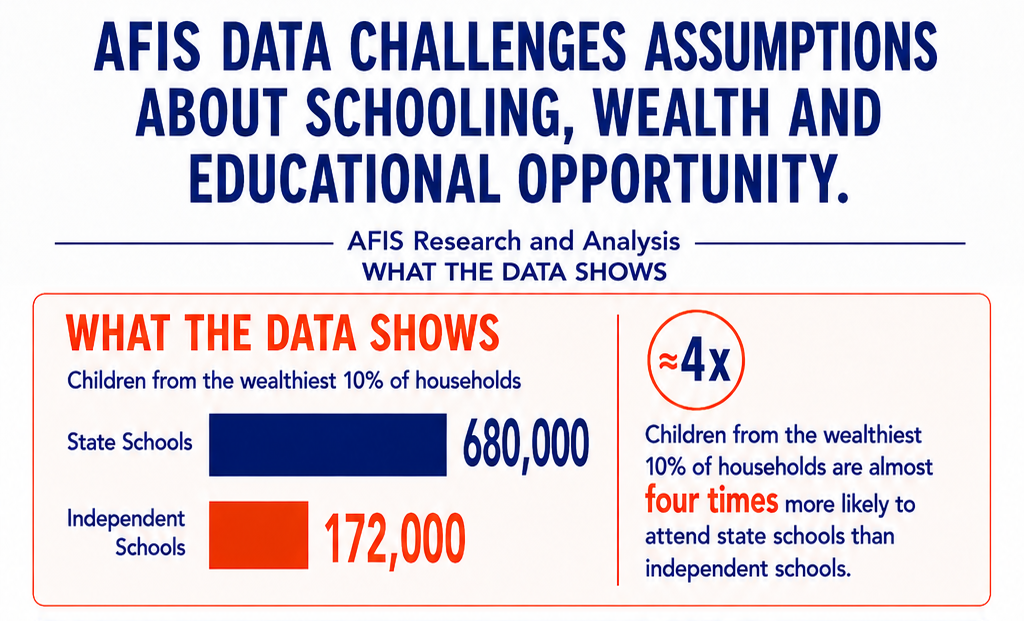
They saw less than half a per cent of independent schools and assumed they represented the other 99.5%.
They saw the “privilege” of the few and assumed it applied to the many.
They didn’t see the small faith schools, local community schools, charitable schools, SEND provision, means-tested fee support, and the countless families making significant sacrifices because they believe a particular school is right for their child.
Assumptions, stereotypes and selective narratives were often allowed to fill the gaps where evidence should have existed.
This created fertile ground for ill-informed public support for policies such as VAT on fees.
Those assumptions should have been challenged with evidence.
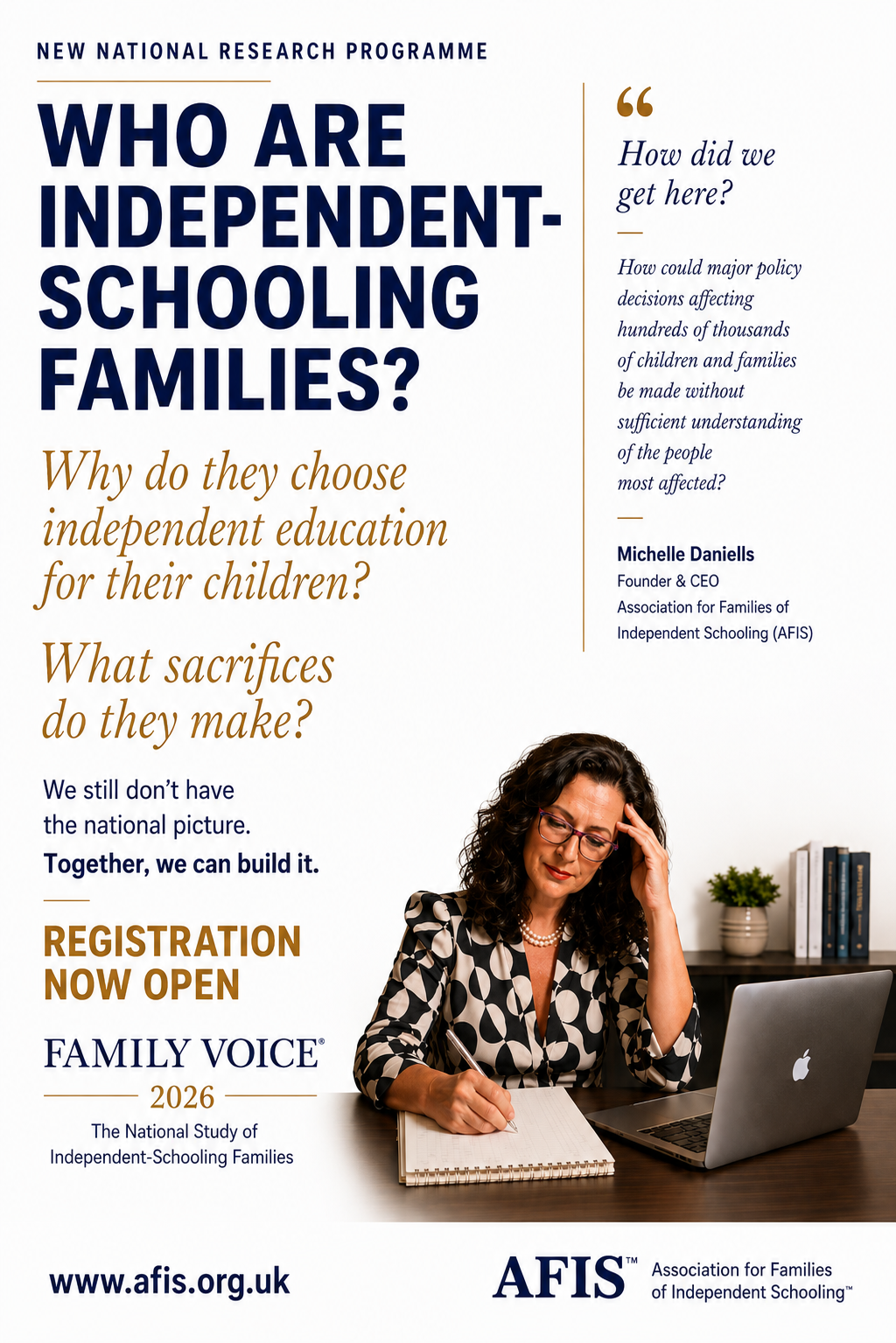
The reality is that research had not been done into who independent school families and why they choose independent education.
I wish it had been done years ago.
AFIS was established in 2025 to make sure it is done now so those critical evidence gaps can be filled.
Our aim:
To ensure decisions affecting children and families are informed by evidence rather than assumptions; by understanding rather than stereotypes.
To improve public understanding and help end the profiling, labelling and prejudicial treatment of children based solely on the type of school they attend.
We are not simply documenting the problems.
AFIS is taking evidence directly to policymakers, regulators, journalists, editors and relevant organisations .
And families finally have a credible, legally structured platform through which their voices can be heard.
For too long, we have been unheard and misrepresented.
Our voices matter.
We must be BETTER PREPARED before the next general election:
Better questions lead to better evidence.
Better evidence leads to better debate.
Better debate leads to better policy.
Because the long-term solution is not just opposing bad policy;
It is building a stronger evidence base, challenging lazy assumptions and ensuring families have a credible voice in the conversation.
If you care about these issues, I encourage you to join AFIS today.
Membership is free.
Every voice matters.