Download AFIS Whitepaper HERE:
New AFIS whitepaper challenges familiar assumptions about wealth, privilege and educational advantage, revealing surprising findings about where wealthy children are educated, what parents can afford, and how children's educational pathways change over time.
19 November 2026 | AFIS Research | BEYOND SCHOOL LABELS
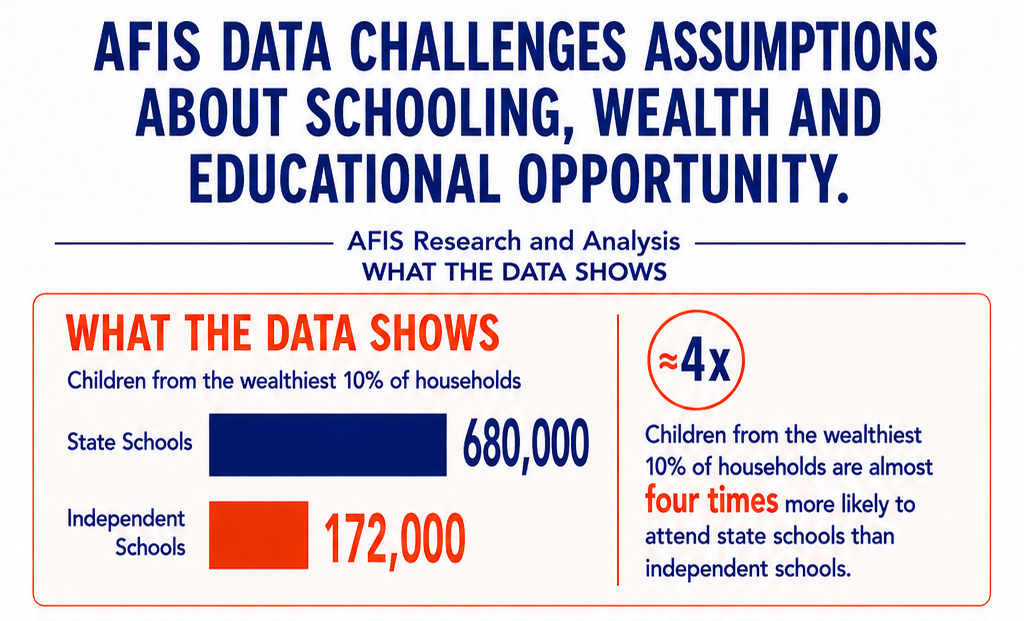
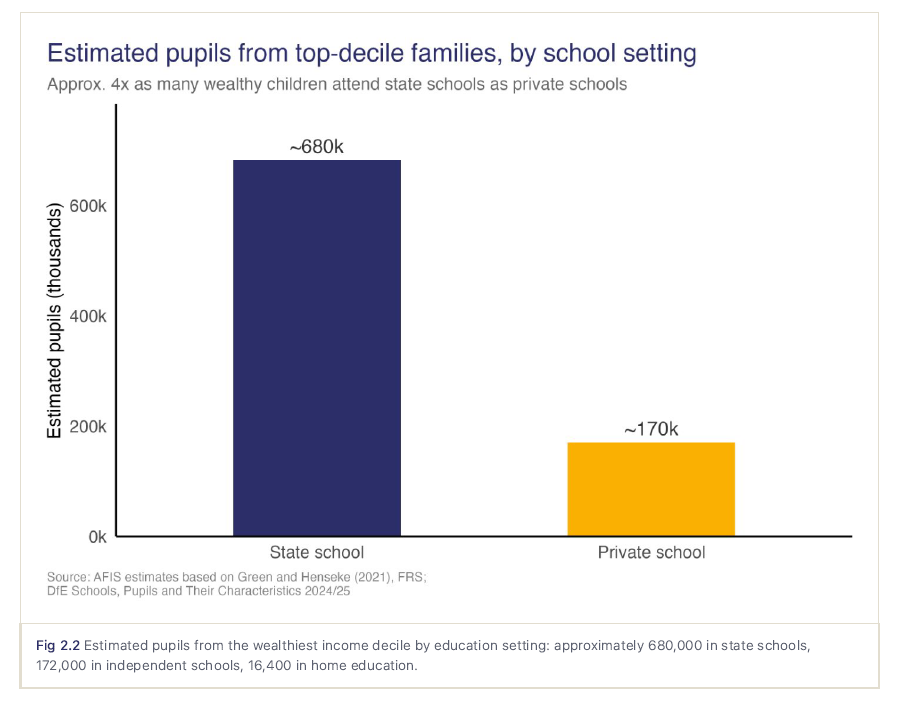
There are approximately four times as many children from the wealthiest 10% of households in state schools as there are in independent schools.
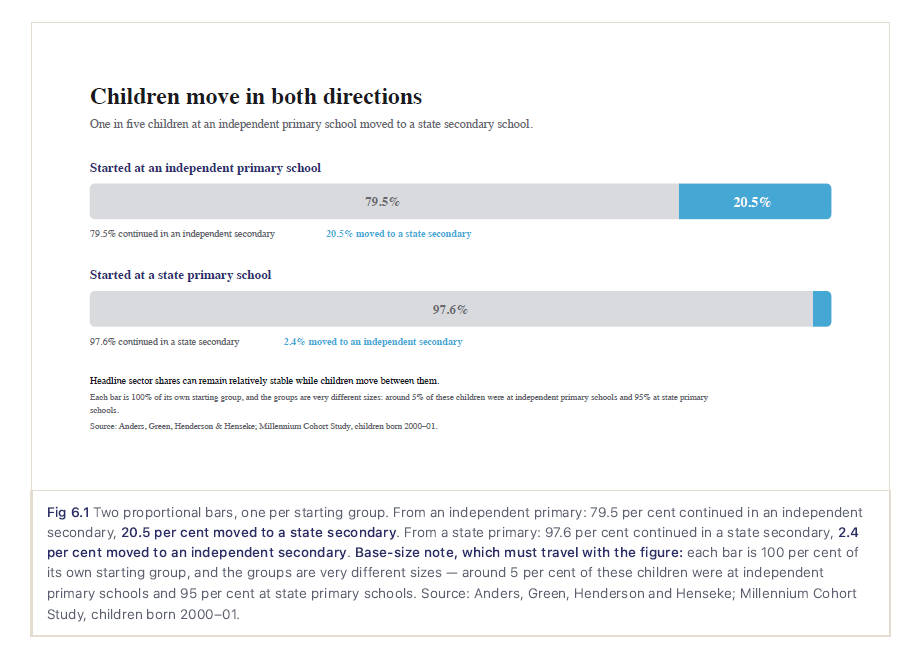
Around one in five children who attended an independent primary school in a major longitudinal study went on to attend a state secondary school.
And one of the most striking findings in the research on academic outcomes is that the apparent GCSE advantage associated with independent schooling largely disappears once differences in family background are taken into account.
These are among the findings brought together in a new whitepaper published by the Association for Families of Independent Schooling (AFIS), which asks a deceptively simple question:
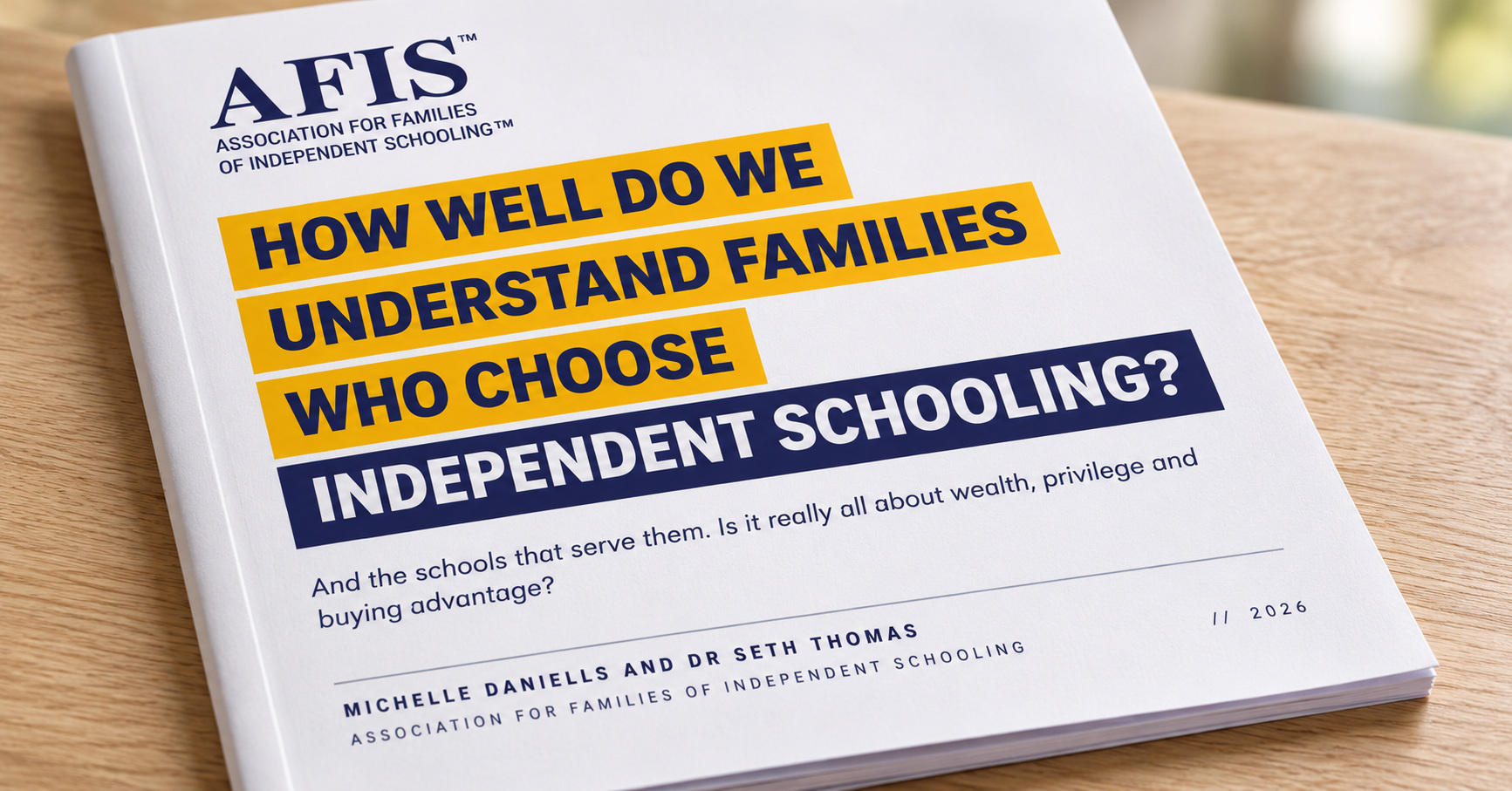
How Well Do We Understand Families Who Choose Independent Schooling?
Written by AFIS Founder and Chief Executive Michelle Daniells and Head of Research Dr Seth Thomas, the paper examines five widely held assumptions about families who choose independent education, testing them against available research and identifying significant gaps in what is actually known.
Its central conclusion is not that wealth and privilege are irrelevant. The evidence clearly demonstrates that household income and wealth strongly influence access to independent education.
Rather, the question is whether broad statistical patterns have become a substitute for understanding individual families and children, and whether assumptions about their circumstances are being given more weight than the available evidence can justify.
1. Where are the wealthiest children actually educated?
One of the whitepaper's most revealing findings challenges the familiar association between independent schooling and wealthy families.
AFIS estimates that approximately 680,000 children from households in the highest income decile attend state schools in England, compared with around 172,000 attending independent schools.
That means roughly four children from the wealthiest tenth of households are educated in state schools for every one in an independent school.
The finding does not contradict the substantial evidence that independent-school participation is concentrated among wealthier households. Indeed, the whitepaper examines that evidence in detail.
But it raises an important question about the use of school type as a proxy for wealth.
If the majority of children from the wealthiest households attend state schools, what can we reliably conclude about any individual child's financial circumstances simply from knowing which sector they attend?
And when policies or opportunities are intended to address disadvantage, should eligibility depend primarily on a school's funding model — or on the circumstances of the child?
2. What do we actually know about the families paying school fees?
It is often assumed that families choosing independent schooling have sufficient financial resources to meet the costs, including substantial fee increases.
The evidence presents a more complicated picture.
Research by University College London, drawing on the Family Resources Survey, found that the cost of educating one child privately had risen to more than half of net family income per family member for households in every income decile except the highest.
The researchers also found that income alone did not adequately explain participation among families outside the wealthiest decile. Housing wealth appeared to play an important role.
But that leaves significant unanswered questions.
How many families pay fees from current earnings? How many rely on savings, housing equity, inherited wealth or financial assistance from grandparents? How long can those arrangements continue? And what happens when family circumstances change?
A 2025 Parentkind/YouGov survey found that 19% of independent-school parents reported contributions from grandparents towards school fees.
Separate research cited in the whitepaper indicates that families may reduce other household expenditure, savings or pension contributions to maintain their children's education.
AFIS's own parent surveys provide further examples of these pressures, although their small, self-selected samples mean they cannot be treated as nationally representative.
This distinction matters.
A family with a high household income, substantial assets and little financial pressure may be in a very different position from a family relying on grandparents' savings, remortgaging or sacrificing retirement provision.
Yet both families' children are placed in the same educational category.
The whitepaper also presents indicative estimates of the income distribution of independent-school households, including a substantial proportion below £100,000 in annual net household income. These are explicitly identified as approximations derived from available survey evidence, rather than official statistics.
The problem is not that every independent-school family is financially stretched. Many are not. It is that we lack sufficiently comprehensive, representative information to establish the full picture.
3. Are parents buying an academic advantage, or does family background explain more than we think?
Independent schools frequently achieve strong examination results. But how much of the difference is attributable to the schools themselves, and how much reflects the circumstances of the children attending them?
The whitepaper examines research by Anders and colleagues, published in 2024, using data from the Millennium Cohort Study.
The researchers identified a substantial unadjusted difference in GCSE performance between independently and state-educated pupils.
However, when socioeconomic background was taken into account, that estimated difference fell dramatically and was no longer statistically significant.
Further adjustments for demographic characteristics, prior attainment, parental values and geography did not restore an independent-school advantage.
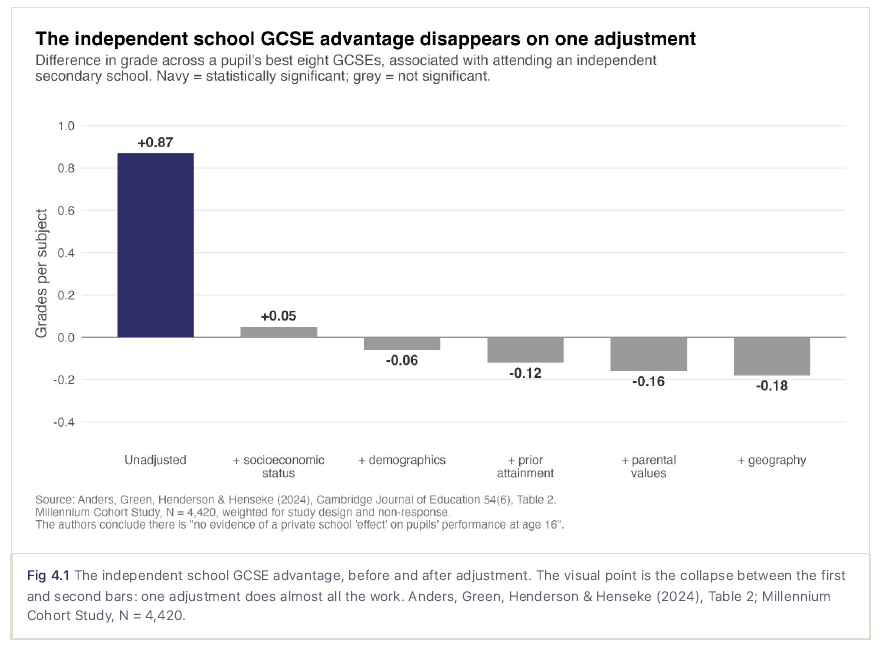
This is a potentially important finding for discussions about educational advantage and social mobility.
It does not establish that independent schools make no difference to children. Nor does it mean that every school provides the same educational experience or that examination results are the only outcomes that matter.
It does, however, challenge the assumption that differences in headline examination performance can automatically be attributed to school type.
The whitepaper also considers evidence about high-performing state schools, faith schools and private tutoring, illustrating the wider range of factors that may influence educational outcomes.
If we want to understand what helps children flourish, we need to look beyond school labels.
4. The 93% and 7% are not two fixed groups of children
Public debate frequently divides children into two populations: the approximately 93% educated in state schools and the minority educated independently.
These figures describe school attendance at a particular point in time. They do not necessarily describe a child's entire educational journey.
Research examined in the whitepaper found that 20.5% of children attending independent primary schools subsequently attended state secondary schools.
Movement also occurred in the opposite direction, although at a lower rate: 2.4% of children attending state primary schools moved into independent secondary education.
The research also identified families in which siblings attended different types of school.
These findings matter because a child may be independently educated for only part of their childhood. A change in family circumstances, a particular educational need, the availability of financial assistance or a move between schools can all affect that journey.
Yet school-sector categories are increasingly used as though they describe permanent characteristics of individuals.
As the whitepaper puts it:
“A school has a sector. A child has an educational pathway.”
The distinction is particularly important when educational background is used to determine eligibility for opportunities, support or programmes intended to promote social mobility.
5. When assumptions about wealth begin to influence decisions affecting children
For Michelle Daniells, the questions behind the whitepaper emerged from both personal experience and a growing concern about the influence of assumptions in public debate and policymaking.
Daniells was educated in the state sector, left school at 16 and did not attend university. Her own children began their education in state schools before moving into independent education with the assistance of means-tested fee support and financial help from grandparents.
The experience challenged some of her own preconceptions.
“I encountered families with very different backgrounds, circumstances and reasons for choosing independent schooling. Some were undoubtedly wealthy, but others were making considerable sacrifices or relying on support from relatives.
“I also saw how children's needs and family circumstances could change over time. It became increasingly difficult to reconcile those experiences with the rather simplistic picture of independent-school families that dominated much of the public discussion.”
Daniells is careful not to suggest that her own experience, or those of families she has encountered, provides representative evidence.
Indeed, that is precisely why she began asking where the more comprehensive research could be found.
Another important trigger came in July 2025, when The Stage reported criticism by Simon Hyde, General Secretary of the Headmasters' and Headmistresses' Conference, of differential ticket pricing for state and independent-school groups at the National Theatre and Royal Shakespeare Company.
The article's headline referred to “crude wealth assumptions”.
For Daniells, the issue went beyond the additional cost of a theatre ticket.
The theatres' objective of widening access to the arts was understandable. But the controversy illustrated how school type could be used to make assumptions about families' financial circumstances, with practical consequences for children.
“It made me think much more seriously about the extent to which assumptions about wealth and privilege were influencing decisions affecting children and families. The theatre pricing was one example, but the same underlying questions seemed relevant to much bigger policy decisions.
“I began asking why, if these assumptions carried so much weight, we did not have better research into the families themselves. How much did we actually know about their circumstances, how they financed their children's education, or why they had chosen independent schooling?
“That question became central to our research. A binary school label is not a biography of a child or a family.”
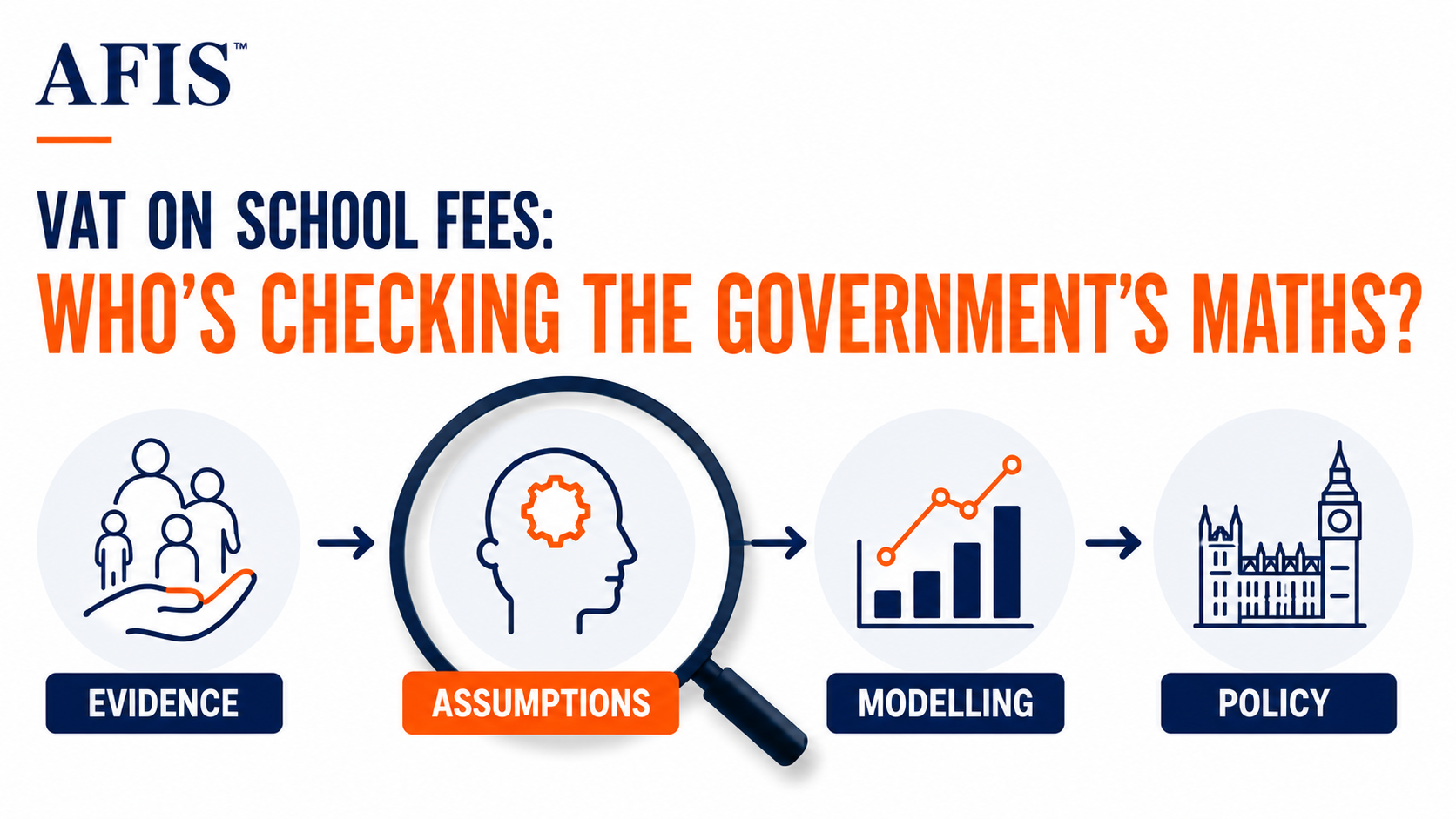
The concern became particularly pressing during the debate surrounding the introduction of VAT on independent-school fees.
Predicting how families would respond to a substantial increase in costs required assumptions about their financial resilience, how they paid fees and how quickly they might change their children's schooling.
Yet some of the information necessary to understand those decisions was either limited, outdated or simply unavailable.
The whitepaper examines these evidence gaps without seeking to make a general argument for or against the tax itself.
Its broader question is one of evidence and accountability: how confidently should policymakers predict family behaviour when important aspects of those families' circumstances remain unmeasured?
6. What happens when a school label determines eligibility?
The paper also considers the consequences of treating school type as an indicator of an individual child's advantage or disadvantage.
It examines how educational background can influence eligibility for widening-participation initiatives and other opportunities.
One example concerns the eligibility criteria for Oxford University's UNIQ access programme, which, when examined for the whitepaper, excluded pupils currently attending independent schools, including those receiving bursaries or scholarships.
This is not a restriction on applying to Oxford University itself. It is an example of a particular access programme using school type as an eligibility criterion.
Such programmes have legitimate aims, including improving access for disadvantaged young people.
The question raised by AFIS is whether a child's current school category always provides a sufficiently accurate indication of their circumstances.
A pupil receiving substantial means-tested assistance may face financial or personal challenges that are not visible from the school they attend.
Equally, a child from a very wealthy household attending a state school may not experience the disadvantages that a school-sector classification could imply.
The whitepaper does not argue that disadvantage should cease to matter. It argues that disadvantage should be identified as accurately as possible.
That principle should apply to children in every educational setting.
7. Why the evidence gap matters for all families
One of the paper's most significant conclusions is that the missing evidence is not solely a problem for independent education.
There is extensive research about schools, their governance, funding, admissions, teaching and examination results. There is also important research about parental engagement and educational outcomes.
But comparatively little nationally representative evidence captures the full range of family circumstances, motivations, constraints and educational decisions across both sectors over time.
This matters for social mobility, educational opportunity and public policy.
Parents and carers make decisions within circumstances that are rarely static. Their finances change, children develop different needs, local schooling options vary and family priorities evolve.
Understanding those decisions requires more than identifying the type of school a child happens to attend.
The whitepaper also highlights a particularly important missing comparison: outcomes for independently educated children compared with those of equally advantaged children attending state schools.
Without that comparison, it is difficult to distinguish the influence of schooling from the influence of family background.
The authors argue that better linked administrative data, research into household finances and a more systematic approach to understanding educational pathways would help address these gaps.
8. AFIS calls for national longitudinal research and a stronger family evidence base
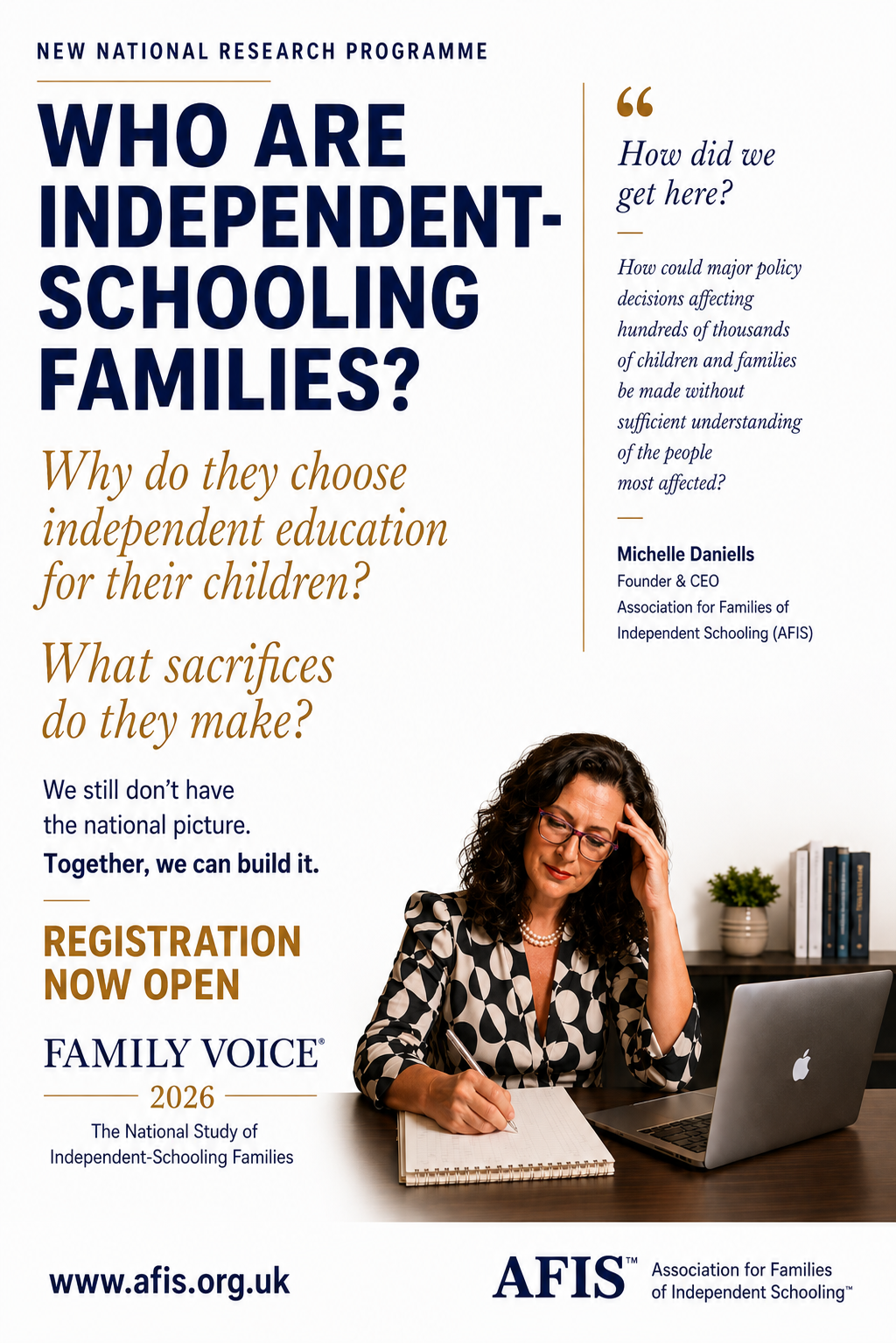
AFIS is calling on the Government, the Independent Schools Council (ISC) and its constituent associations to take a more active role in commissioning and supporting independent research into families who choose independent schooling.
The whitepaper sets out a series of research priorities, including better information about household finances, fee funding, family motivations, educational pathways, policy impacts and outcomes.
AFIS believes these recommendations should form the basis of a nationally representative longitudinal study, following children and families over time, supported by regular cross-sectional research across educational settings.
Such an approach would allow researchers to examine not only where children are educated, but why families make particular choices, how those choices change, and what happens to children as their circumstances and educational pathways evolve.
It would also provide a more reliable foundation for evaluating the consequences of public policy.
The paper recommends a standing national conversation with parents, including regular, comparable research across different educational pathways.
Daniells says:
“We are not asking policymakers or the public to accept our assumptions about these families in place of somebody else's.
“We are asking why there has not been a more systematic effort to understand them.
“If we are serious about educational opportunity, social mobility and making well-informed decisions in the interests of children, we need better evidence about families, not simply more statistics about the schools their children attend.
“This is an opportunity for the Government, the ISC, researchers and others to work together constructively. The benefits of better evidence would extend well beyond independent education.”
9. BEYOND SCHOOL LABELS: understanding children before categorising them
The whitepaper forms part of AFIS's wider BEYOND SCHOOL LABELS: Rethinking Social Mobility and Social Cohesion Through Schooling programme.
The programme challenges the tendency to treat the categories of state and independent education as though they provide a complete account of a child's background, circumstances, needs or opportunities.
It seeks to encourage more thoughtful, evidence-led discussion about educational choices and outcomes, while recognising the diversity of families within both sectors.
This work also complements AFIS's BETTER PREPARED 2026–29 programme, which aims to strengthen evidence, understanding and preparedness among families and stakeholders in an increasingly challenging educational environment.
For AFIS, the objective is not to minimise the importance of wealth or the inequalities that exist in education. It is to ensure that those inequalities are understood accurately, and that children are not judged solely by a category they did not choose.
The whitepaper's conclusion is deliberately straightforward:
“Before we decide what families have, what motivates them, what they can afford, what their children need, or how they will behave, the least we should do is ask them.”
DOWNLOAD THE FULL AFIS WHITEPAPER:
How Well Do We Understand Families Who Choose Independent Schooling?
Is it really all about wealth, privilege and buying advantage?
By Michelle Daniells and Dr Seth Thomas
Published by the Association for Families of Independent Schooling (AFIS), November 2026.
DOWNLOAD THE FULL AFIS WHITEPAPER HERE:
AFIS welcomes engagement with researchers, policymakers, parliamentarians, schools, parents and organisations interested in improving the evidence base for educational decision-making.
Championing Parental Choice. Strengthening Family Voice.