Review date: 2026-03-27
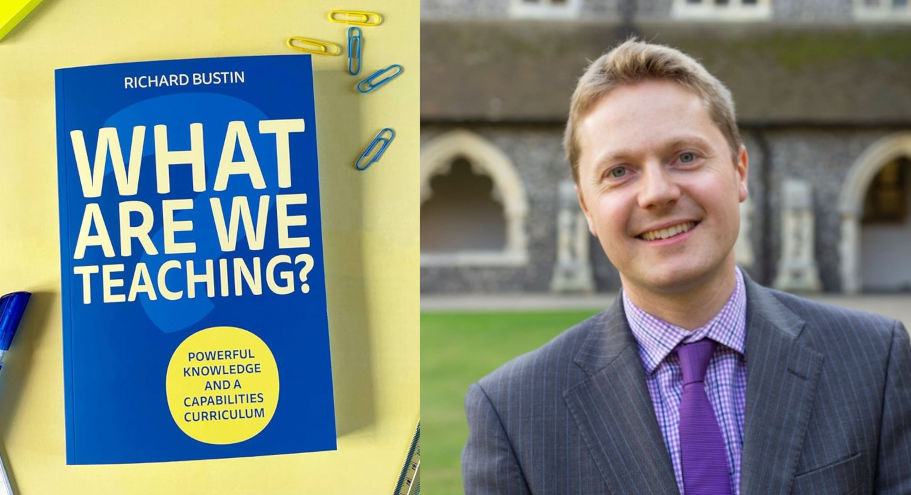
This is a review of What are we teaching? by Richard Bustin, a book for teachers about "powerful knowledge" and how it might impact curriculum design on a subject by subject basis. It is composed of two parts, the first is a review of the literature in the area and the second is the output of research with teachers across the main curriculum subjects in three different schools.
Powerful knowledge was a term coined by David Lambert and Michael Young around 2008. It is a small play on the idea of "knowledge of the powerful" to which it is a counter. It is related to the idea of "capabilities" which grew from the work of Nobel Prize winner Amartya Sen on measuring poverty, welfare and social justice. The goal of using powerful knowledge in determining what is taught is to give pupils capabilities that are useful to them in living their life to the full.
Bustin's main criticism of earlier work in this area is that it tends to be abstract, Sen doesn't even specify capabilities in the area for which he developed the idea. The UN Human Development Index which is based on these ideas focuses on wealth factors and education as key capabilities. The theme of this book is to apply the ideas of powerful knowledge and capabilities on a subject by subject basis. Bustin's background is in geography, where much previous work on capabilities relating to education is found.
A second idea running through the book is "Three Futures" based on a paper by Michael Young in 2010. Future 1 is based on the "knowledge-rich" or traditional curriculum where pupils are taught facts on which they tested in examination. Future 2 is based on a strongly progressive ideology where subjects become secondary to student-led learning with a degree of indoctrination into liberal thinking. Future 3 is Bustin's preferred outcome which blends strong subject-based knowledge with empowerment.
School curriculums are an ideological battleground with different governments pushing different ideological preferences onto schools. "The Corruption of the Curriculum" report (2007) from Civitas is mentioned a few times by Bustin. This edited volume of essays essentially complained that the curriculum had been hijacked by political agendas which had climate science appearing in science lessons, modern writers in English lessons rather than dead old white men and history curriculums with too much focus on diversity and non-colonial viewpoints. It's difficult to tell whether the idea of "powerful knowledge" was a response to this but it was taken up by the Conservative education secretary in 2018.
Beyond political challenges, recruitment of teachers is currently hard, meaning that it is difficult to provide specialist teachers in all subjects. There is also the challenge of "teaching to the test", teachers are under pressure from both school leadership teams and students to teach what is in the test to maximise examination scores.
Turning to the second part of the book; different curriculum subjects vary greatly, some like the sciences have parent academic disciplines based in universities which give a guide as to what to teach and to some degree help in the evolution of curriculums to ensure "best knowledge" is included. In other subjects, like the creative arts and languages, there is limited parent academic activity or it is very different from what is taught in schools. Bustin holds up Latin as a subject which has not evolved and as a consequence is dying out although he acknowledges that its role in reinforcing social division has played a part.
It's difficult to summarise the discussion of individual subjects, in practice teachers reading this book will focus on their own subjects. Bustin summarises the educational capabilities discovered in the second part of the book as follows:
- capabilities associated with students finding new ways to make sense of themselves and the world - this captures the fact-based side of education;
- capabilities associated with different claims to truth - this is about challenging facts presented, particularly relevant in an era of fake news;
- capabilities associated with critical thinking - this is about understanding how truth is established in different subjects which differs subject to subject;
- capabilities associated with choices about how to live and work - this is about empowering students to decide what they want to do with their lives;
- capabilities associated with agency -this is about making moral decisions;
which is likely as good a summary as any. These capabilities include old-fashioned factual knowledge and procedural knowledge (how to do things) but also evaluating potential misinformation.
Interestingly maths has been criticised as being strongly fact-based which surprised me a bit; the reason is that students often learn rules for solving problems by rote rather than general mathematical problem solving skills. A vignette talking about calculating averages and means goes on to talk about sampling and biases and how these might be found in surveys reported in the news this is where maths moves into powerful knowledge. The format on the subject chapters is not rigid but these vignettes are common and provide a quick insight into how these powerful knowledge driven curriculums might look.
This isn't really a book for parents, unless you are curious and have time on your hands. It may be useful to home-schooling parents because it speaks to what you should teach, beyond the bare bones of examination specifications. I certainly found it interesting and well-written.
BIOGRAPHY of Dr Richard Bustin, Author of WHAT ARE WE TEACHING
Dr Richard Bustin is Director of Pedagogy, Innovation and Staff Development and Head of Geography at Lancing College, UK. His research interest in curriculum has resulted in numerous publications, offers to speak around the world and involvement in teacher training. His book 'What are we Teaching?' was Highly Commended in the Teach Secondary Awards 2025 and recognised by the TES as one of the top 7 books all school leaders should read.