By Dr Steven Watson, Associate Professor, University of CambridgeThe public debate about independent schooling in the UK has become increasingly polarised.
What’s often missing is balance, rigour and inclusivity.
The public debate about independent schooling in the UK has become increasingly polarised.
On one side, there are claims of privilege, inequality, and social stratification. On the other,
there are defences of choice, quality, and contribution to public life. But what’s often missing
from this discussion—across media commentary, political rhetoric, and even some
research—is balance, rigour, and inclusivity. Much of the existing data is partial, the framing
often one-sided, and the voices of families who actually choose independent education rarely
heard.
As an academic researcher with a background in education and systems theory, I believe one
of the most constructive things we can do is to improve the quality and integrity of the data
that informs this debate. This doesn’t mean advocating for or against private education per se.
It means committing to the basic principle that if we are to talk about the role of independent
schools in our society, we should do so with evidence that is methodologically sound,
inclusive in scope, and capable of capturing the diversity of what private schooling really
looks like in the UK today.
Too often, we rely on data from narrow samples—such as surveys conducted through wealth
management firms or analyses that disproportionately focus on high-profile institutions like
Eton, Harrow, and Winchester. While these schools undoubtedly have a significant place in
the public imagination, they are not representative of the independent sector as a whole.
There are hundreds of smaller schools—some faith-based, some focused on special
educational needs, others offering pedagogical alternatives—that serve a wide range of
families. These stories, preferences, and contributions rarely surface in the national
conversation.
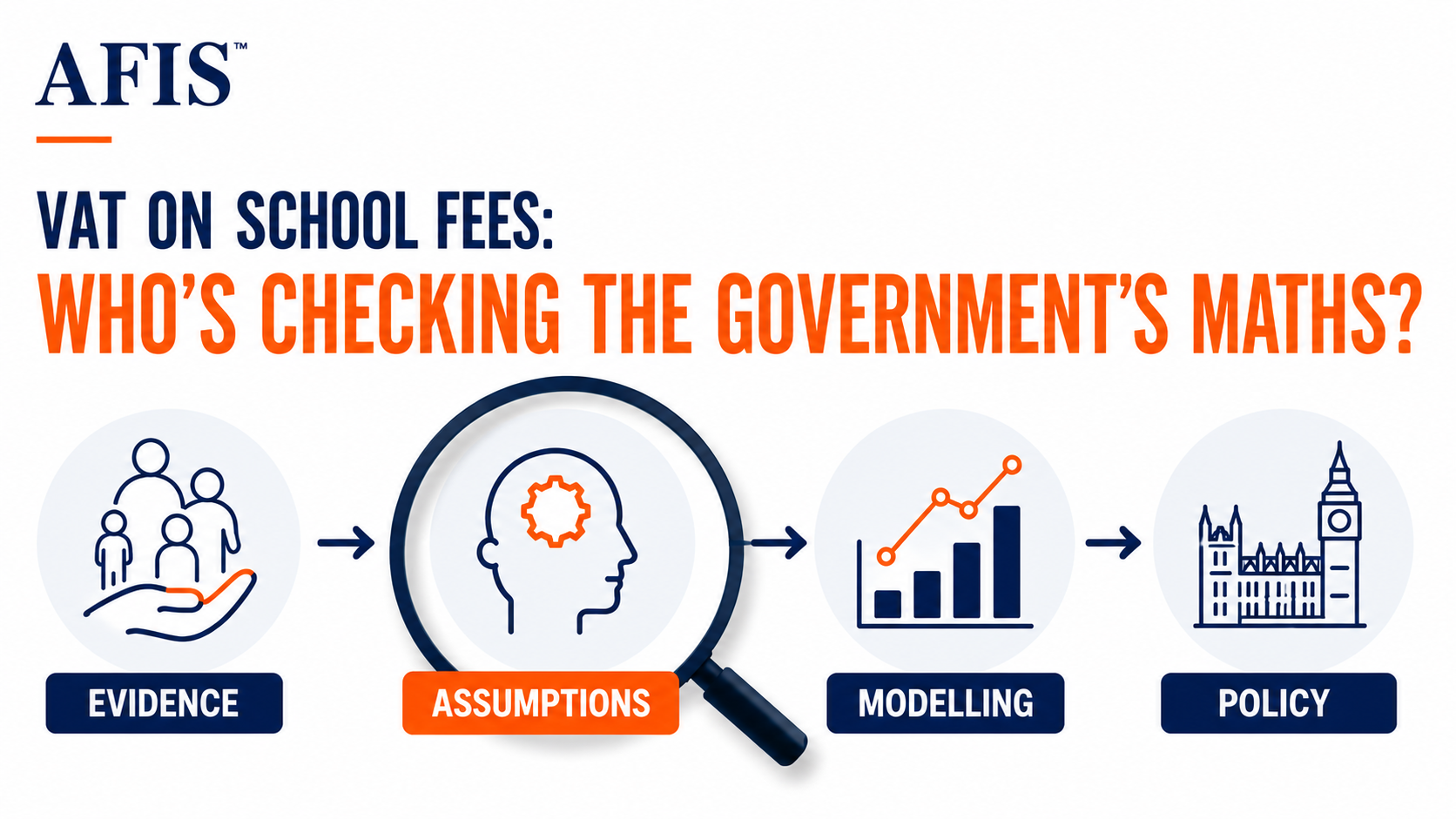
A key example of this gap was highlighted recently in coverage of the proposed VAT changes
on school fees. Several widely-circulated reports suggested that only 3–5% of students might
leave the independent sector if the policy were implemented. Yet emerging evidence suggests
this estimate may be far too low. What’s striking is how little independent, publicly accessible
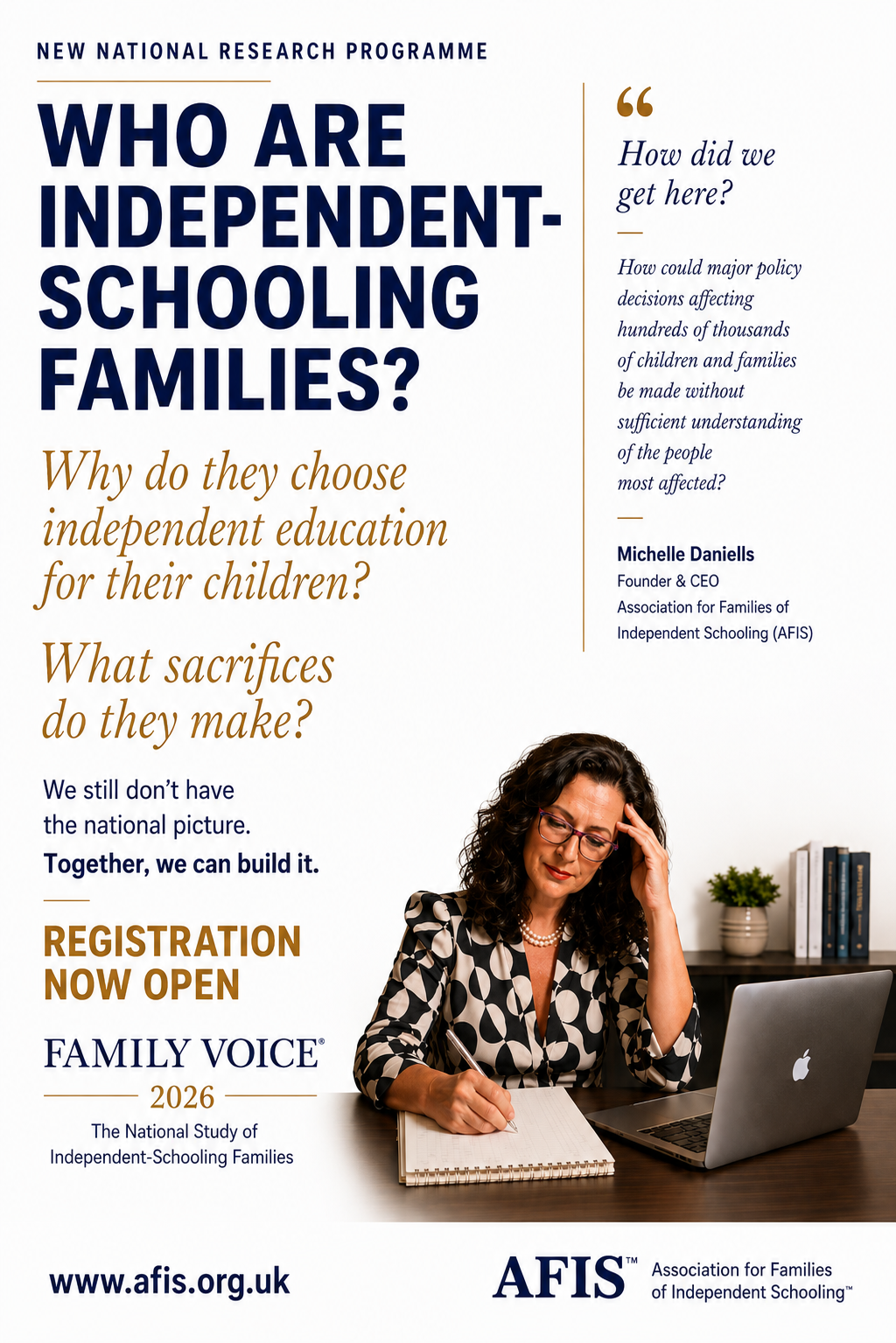
data exists to ground these claims—on both sides. We urgently need research that draws from
a more representative pool of parents and families, including those who are not at the top end
of the income distribution, who make real sacrifices to send their children to independent
schools, and whose experiences are largely absent from current datasets.
This is where AFIS, in my view, can play a meaningful role. By building a platform that
connects with a broad base of independent school families, AFIS has the potential to support
the development of a more representative and transparent research base. Done well, such
research can not only challenge misconceptions, but also elevate the level of public
understanding around who chooses independent education and why.
In this work, objectivity and methodological care are vital. If research is to be seen as
credible, it must avoid becoming another echo chamber. That means including divergent
views, asking challenging questions, and designing studies that are open to complexity and
contradiction. The aim is not to prove a point, but to illuminate a social
phenomenon—private schooling in the UK—in all its diversity, tension, and nuance.My role as Consultant Research Adviser will be to support this effort: helping to shape the
design of research projects, advise on methodological strategies, and ensure that the resulting
work stands up to scrutiny—whether from policymakers, academics, journalists, or the wider
public. This involves more than simply applying established methods. It’s about thinking
systemically: recognising that education is not an isolated field but one that is deeply
entangled with economic, cultural, and technological dynamics.
Ultimately, good research doesn’t give us easy answers. But it does provide a more honest,
thoughtful, and inclusive foundation for decision-making. If AFIS can help generate that kind
of research—rooted in integrity, open-mindedness, and a commitment to truth-seeking—then
it will be a significant and timely contribution to a national debate that badly needs light, not
just heat.__Steven Watson is an Associate Professor in the Faculty of Education, University of Cambridge. He is
also co-founder of the University of Cambridge knowledge enterprise spinout, Cambridge Global
Knowledge Nexus.
His research uses transdisciplinary approaches, social systems theory, cybernetics;
his current focus is on the philosophy and sociology of technology, and in particular the role of
generative AI in organisations, education, and society. While his research is strongly theoretical, he
integrates this with contextual empirical research and development. His previous professions include
secondary school mathematics teacher and telecommunications engineer. He holds degrees in
Engineering from the University of Cambridge, a masters in education from the Open University and
a PhD Education from the University of Nottingham.
He is currently working on four books,
Emergent Discourses on Generative AI in Education and Society (Expected publication 2025),
Generative AI and Meaning Mediation (forthcoming), Autopoietic Ecology (Forthcoming) and
Educational Research: an autopoietic ecological systems approach (forthcoming).

Guest Blog
Rethinking the Debate
AFIS™
If you support parental choice in education and value the work of the Association for Families of Independent Schooling, please consider:
- Helping to recruit new members through your own networks
- Volunteering to work with us, even just for a couple of hours a month
- Becoming an official AFIS Ambassador
- Making a donation
Get in touch with our team: hello@afis.org.uk and get involved
Related Articles

AFIS is a non-profit organisation dedicated to championing parental choice, securing fairer representation for independent-schooling families, supporting members with benefits and resources, and widening access to independent education.
AFIS and Association for Families of Independent Schooling are registered trademarks of AFIS UK LTD.
The Association for Families of Independent Schooling (AFIS) C.I.C. is a community interest company, incorporated in England and Wales, company number 16817786.