By Michelle Daniells
Founder, Association or Families of Independent Schooling
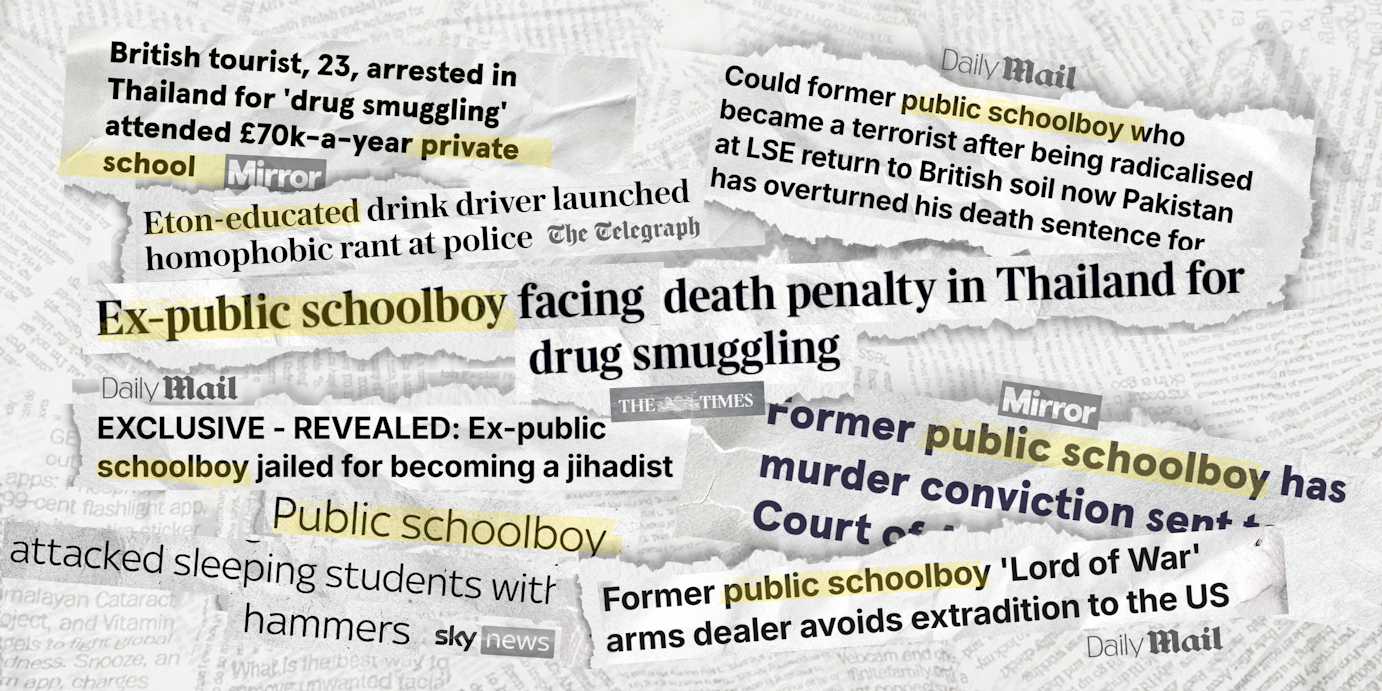
You’d never read a headline that said “State-school educated man jailed for robbery.” It would be
dismissed immediately as irrelevant, prejudiced and absurd. Yet across the British press, I have
counted numerous examples of this, where accused or convicted men are labelled “public schoolboy”,
“ex-public schoolboy” or “Eton-educated”.This double standard is so normalised that few readers even question it. Only last week, The Times
referred to an alleged drug smuggler in Thailand as “public school educated.” In May, the same paper
called a convicted rapist a “former public schoolboy.” What does the type of school have to do with
these crimes? Nothing — except to feed a lazy stereotype and signal to readers that wrongdoing is
somehow more shocking when it comes from a privately educated young man.I write not as a headteacher or member of an establishment family. My children are the first in our family not to be state-educated, thanks to generous means-tested bursary support from Year 7. The
quality of that education impressed me so much that I set up the Association for Families of
Independent Education, a social enterprise giving parents like me a collective voice. And we are tired
of the crude stereotypes, the wealth assumptions and the misinformation that surround our children’s
schooling.
A double standard in reporting
When a crime is reported, details about the offence, the investigation and the verdict matter. The name
of the school someone once attended does not. Yet for some reason, “public schoolboy” is treated as
shorthand for hypocrisy or moral failure. Editors seem to think it adds colour — that it tells readers
“even someone from privilege can fall.”
But here’s the problem: you never see the reverse. Editors instinctively know that writing “state-
school educated man jailed for burglary” would be insulting, irrelevant and prejudiced. And they are
right. The same logic should apply to privately educated people too. To highlight their schooling in
this way is selective, unfair and divisive.
Why it matters
This isn’t a trivial point. Most children have no say in the school their parents choose for them. To use
that detail against them in adulthood is to hold them responsible for decisions they never made. It also
casts a shadow over entire school communities — pupils, teachers, families — who are unfairly
implicated by association.
Worse still, it feeds into a damaging “us versus them” narrative. By presenting crimes as somehow
more newsworthy when committed by the privately educated, newspapers encourage social division
and resentment. It reinforces stereotypes of “posh hypocrisy” and invites readers to sneer, instead of
focusing on the crime itself.
What would be better?
If education is genuinely relevant to patterns of crime, then let’s see proper journalism: research into
the backgrounds of prisoners, comparative data on outcomes, thoughtful analysis about how
opportunity and inequality intersect with offending. That would be informative. That would add value.
Simply dropping “Eton-educated” or “former public schoolboy” into a headline is not analysis. It is lazy shorthand.
And it adds nothing to readers’ understanding of what happened, why it happened, or what justice requires.
A personal perspective
I am not a defender of privilege. I did not grow up in an independently educated family. My children
are the first in our family to attend an independent school, thanks to means-tested bursary support and
the kind contribution of grandparents. Their education has been transformative. It has also opened my
eyes to how many myths and stereotypes exist about families like mine. That is why I founded the
Association for Families of Independent Education: to provide a collective, national voice for parents
who are fed up with crude assumptions of wealth and unfair portrayals.
We already save the taxpayer billions each year by educating our children outside the state system.
To suggest that our communities should also carry the burden of stigma when one individual offends is
profoundly unjust.
A call for fairness
Crime reporting should be judged by accuracy, fairness and relevance. Whether someone attended
Eton, Harrow or the local comprehensive is not relevant to their offence. The focus should be on
actions, motives, evidence and justice — not parental choices made years earlier.
I urge editors to recognise this double standard and put an end to it. By doing so they could lead the
way in showing that fairness in reporting matters more than easy stereotypes.
Until then, every “public schoolboy jailed” headline will continue to fuel division and mistrust —
when what we need most in our media is clarity, accuracy and unity.