Originally posted July 20, 2026 on LinkedIn:
WHY I'M WRITING THIS NOW
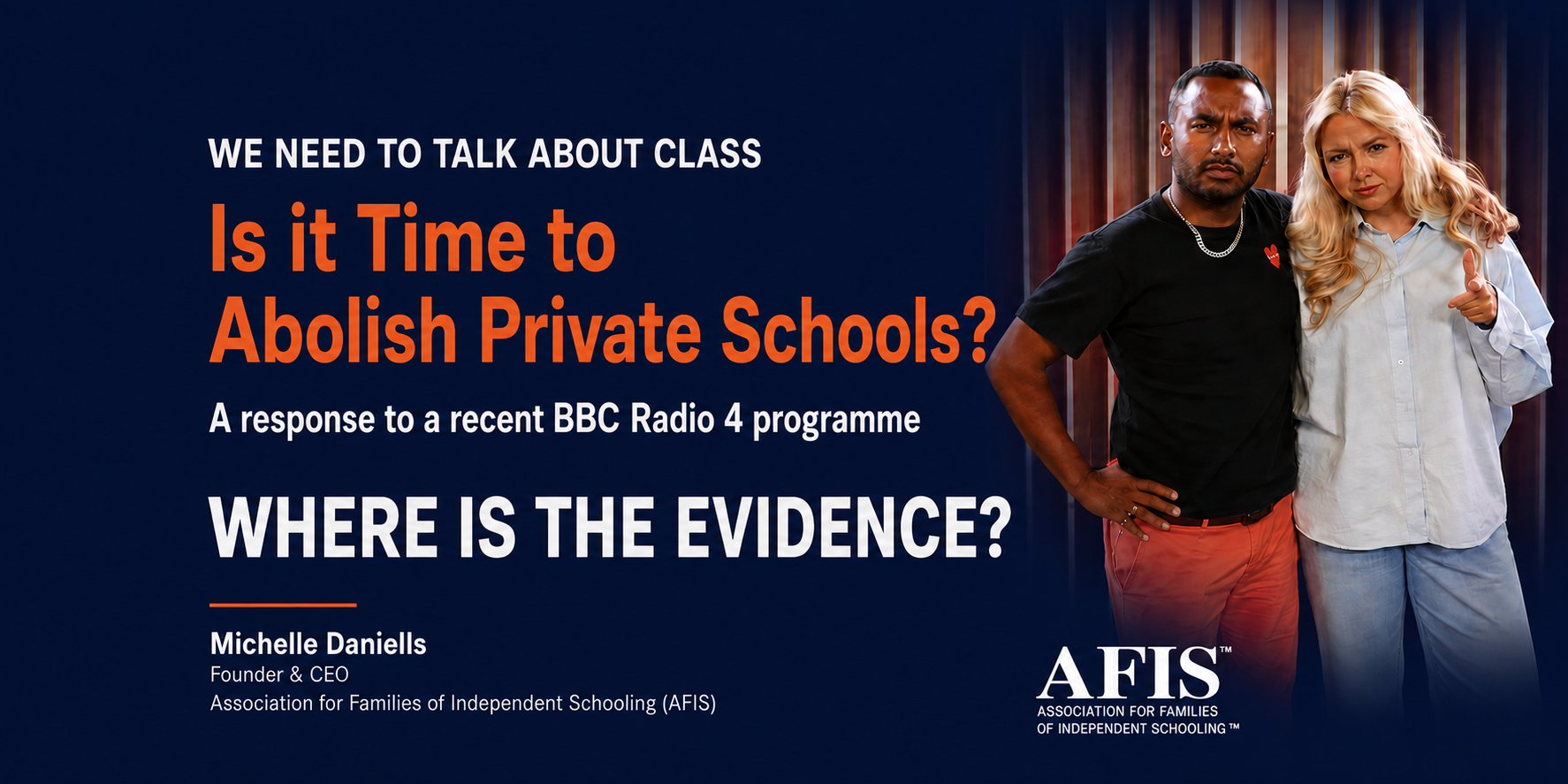
The catalyst for publishing this article was the recent BBC Radio 4 programme, presented by broadcaster and journalist Amol Rajan and featuring Sophie Pender, founder of The 93% Club.
I am the founder and CEO of the new Association for Families of Independent schooling (AFIS), a non-profit community interest company dedicated to championing parental choice in education and advocating for fairer representation of independent schooling families.
In the days following the programme, I was contacted by parents with children at independent schools, parents of former pupils, alumni, teachers and school leaders. Many were frustrated by what they saw as inaccuracies, stereotypes and sweeping generalisations about independent-school children and families throughout the programme. Several also questioned why a serious interviewer did not probe more deeply or ask for stronger evidence to support some of the broader claims and assumptions being presented.
I fully understand many of those concerns.
In his post introducing the programme, Amol explained that Sophie thinks:
"........we get social mobility largely wrong, and that it is absurd to talk about it without talking about the need to abolish private schools, which she would phase out."
(The irony is not lost on me: abolish private schools; then become the 100% Club; but wait.......... then what are we fighting against and why would The 93% Club even exist?)
The 93% Club's own website states:
“Despite making up 93% of the UK population, state-educated people are vastly underrepresented in virtually every top institution, with private school alumni making up 65% of FTSE 350 CEOs, 57% of Peers, 52% of diplomats, 44% of columnists, 46% of corporate lawyers, and 59% of permanent secretaries.
"This disparity is driven by the exclusive networks private schools provide, offering lifelong opportunities and connections that state school students often lack."
These are significant causal claims. I believe they offer an overly simplistic explanation for a far more complex reality. The statement makes no distinction between different kinds of independent schools. It simply refers to "private schools". It seems to imply that people are either 100% "state-educated" or 100% "privately educated", which is simply not the case.
Nor does it acknowledge that there are other different routes into successful schooling outcomes, including academically selective state grammar schools, high-performing comprehensive schools and selective sixth-form colleges, which also deliver strong progression to leading universities and professions.
For these and many other reasons, I would like to see the evidence that allows such broad causal claims to be made with such confidence.
This article is not intended as a personal response to Amol Rajan, Sophie Pender or the 93% Club, nor does it seek to diminish the value of research into social mobility, unequal access to opportunity or the over-representation of independently educated people in some influential professions. Those are important areas of enquiry.
The question raised here is a different one.
Have the assumptions that have become attached to Britain's familiar "93% state / 7% independent" labels, and their growing use as proxies for wealth, privilege, disadvantage, family circumstances, opportunity and educational need, ever been comprehensively tested before becoming so influential in public attitudes, institutional practice, education policy and fiscal policy?
This is not another argument about VAT on private school fees, nor is it a defence of private schools. I support both state and independent schooling, parental choice and the diversity of schooling provision that allows families to seek the education they believe is right for their children at a particular time and in particular circumstances.
AFIS will soon release a discussion paper, entitled:
BEYOND SCHOOL LABELS: Rethinking Social Mobility Through Schooling:
8 Reasons Britain Should Stop Categorising and Judging Children and Families Through its Familiar "93% State / 7% Independent" School Labels
Questioning the assumptions influencing public attitudes, institutional practice, education policy, fiscal policy and social cohesion.
That paper explores how a descriptive classification of schools has became a framework for profiling children and families without sufficient evidence that it can reliably perform that role.
This article does not include detail of all those 8 reasons; rather, it uses the insights gained from the past 18 months of research undertaken by the Association for Families of Independent Schooling, to challenge the way in which the entrenched, simplistic binary labels of “state-educated” or “privately educated” and the associated 93% and 7% are used to justify the call to abolish private schools, by organisations such as The 93% Club, and the way in which people are treated, according to these labels.
WHY THIS MATTERS
Assumptions attached to Britain's familiar "93% state / 7% independent" school labels no longer influence only public opinion. They increasingly influence education policy, fiscal policy, social discourse and cohesion and the way children and families are understood and treated.
They even underpin the mission of a growing national organisation that ultimately wants to see independent schools abolished.
I believe children, families and entire school communities are already paying the price for major policy decisions shaped, at least in part, by assumptions that have never been comprehensively tested. The introduction of VAT on independent school fees is one obvious example. On what basis can people assume that everyone educated in private schools is universally “posh, rich and privileged”. And conversely, how can it be assumed that everyone educated in state schools is from a working class background and disadvantaged?

And what about the many people who attend both state and independent schools, at different times in their schooling journey, for particular reasons in particular circumstances?
The consequences of the stereotypes and generalisations extend much further than taxation; they increasingly influence who is considered eligible for opportunities, the assumptions people make about children's backgrounds and family circumstances, media headlines and images, and the way some organisations, institutions and even public bodies treat children simply because of the binary administrative label attached to a school they attend, or once attended.
I also believe these increasingly influential binary labels risk undermining social cohesion by encouraging people to view children and families through broad administrative categories rather than as individuals with unique backgrounds, experiences and schooling journeys.
One of the principles on which AFIS was founded is that parents should be free to choose the educational setting they believe is right for their child. We may not all make the same choices, but in a diverse society we should respect the fact that different children have different needs, different circumstances and different schooling journeys.
That principle is already recognised by government itself.
Local authorities routinely fund placements at independent schools for children with Education, Health and Care Plans where those schools are judged best able to meet a child's needs.
Less well known is the Department for Education's Broadening Educational Pathways programme. Through this initiative, care-experienced young people, including some living in full-time residential care, are offered free places at outstanding independent day and boarding schools because of the education, pastoral support and stability those schools can provide. These places are fully funded by the participating schools and charitable donations, often covering more than 100% of the fees. So, it is the independent school families who pay the school fees, and the alumni and others who make philanthropic donations to those schools, who contribute to providing these life-changing opportunities to children in care.

(AFIS estimates that many of these placements save local authorities up to £311,000 per child per year compared with alternative care and education arrangements).
If government itself recognises that independent schools are sometimes the right educational choice for some of our most vulnerable children, should families who reach the same conclusion for their own children, for the myriad of reasons they do, automatically be viewed through assumptions and stereotypes simply because of the administrative label attached to the school they choose?
THE QUESTION I WOULD LIKE TO ASK
I'd like to ask Amol Rajan and Sophie Pender a question.
What robust evidence demonstrates that the type of school a person attends, or attended at some point during their childhood, is a reliable proxy for their background, family circumstances, needs, opportunities, social capital or future prospects?
One of the biggest problems with the "93% versus 7%" narrative is that it encourages people to make broad, crude assumptions, rely on stereotypes and infer far more about children and families than these simple binary school labels can reliably tell us.
Personally, I am more interested in strengthening social cohesion and contributing to evidence-led debate than reinforcing labels that divide people into opposing groups.
BEFORE WE DRAW CONCLUSIONS ABOUT CHILDREN AND FAMILIES...
Children attend independent schools for an enormous variety of reasons.
Many receive means-tested bursaries, including my own children.
Many have parents making extraordinary financial sacrifices to do what they believe is best for their children.
Some attend specialist independent schools because their local authority cannot provide suitable state provision.
Others attend because of SEND (with or without EHCPs), military mobility, faith, family values or because their parents have exercised a legitimate choice based on what they believe is the right school for that particular child.
Some parents turn to independent schools only after their child has experienced repeated difficulties in state schools, including persistent bullying, unmet special educational needs, poor mental health or an educational environment that simply was not right for that individual child for a variety of valid reasons.
Before drawing conclusions from the school a person attends, or once attended, we should first understand why they went there in the first place.
If school attendance reflects an educational decision made by parents in particular circumstances at a particular point in a child's life, how can it also be assumed to be a reliable indicator of that child's identity, family circumstances or future prospects?
THE REALITY IS FAR MORE COMPLEX
Independent-schooling families and the approximately 2,500 schools that serve them are incredibly diverse.
Yet the independent sector is still too often viewed through the lens of a relatively small number of historic institutions such as Eton and Harrow. As a result, independent-schooling families are frequently assumed to be broadly affluent, privileged and homogeneous.
The reality is far more complex. Many people appear to assume that paying school fees is, in itself, a reliable indicator of wealth and privilege, while not paying school fees indicates a working-class background or disadvantage. I do not believe the evidence supports such broad generalisations or stereotypes.
It was precisely these widely accepted assumptions that prompted AFIS to begin asking much deeper questions.
One of the first findings from our research may surprise you.
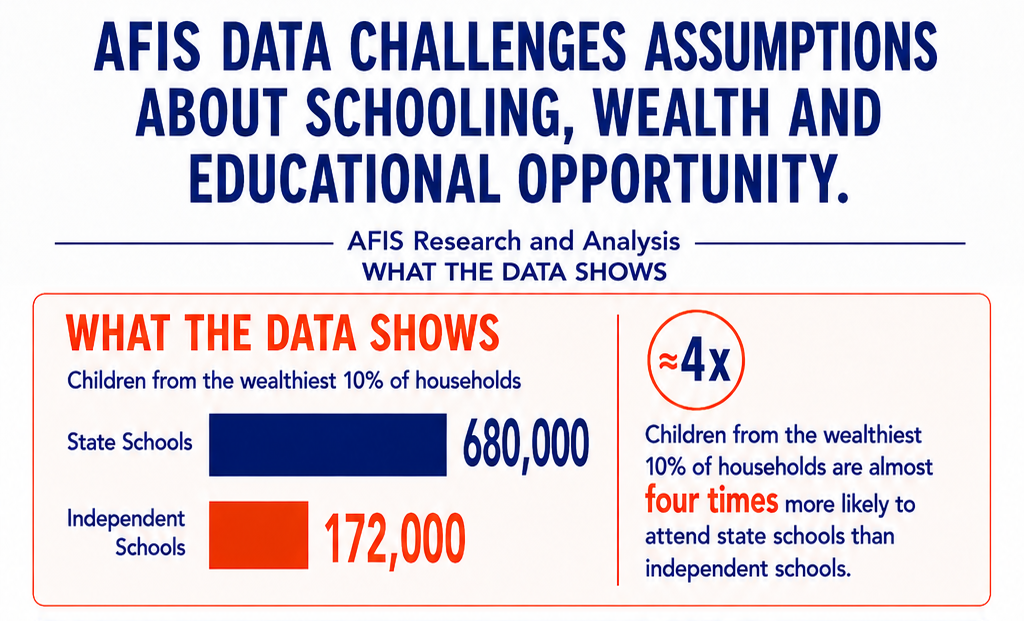
There are around four times as many children from the UK's highest-income households attending state schools as there are attending independent schools.
In fact, there are more children from the wealthiest households in state schools than there are pupils in the entire independent sector.

ARE WE ASKING THE RIGHT QUESTIONS?
Why do people treat binary "state or independent" school labels as proxies for educational disadvantage and advantage?
There are different routes into high-quality schooling that increase the likelihood of successful schooling outcomes and progression into leading universities and professions.
These include independent schools, grammar schools, high-performing comprehensive schools, high-performing faith schools and selective sixth-form colleges.
Families gain access through different mechanisms.
Some pay school fees.
Some receive means-tested bursaries.
Some secure places through academic selection in both independent and state schools. (Contrary to popular opinion, a large number of independent schools are not selective).
Others purchase homes in the catchment areas of high-performing state schools, at a substantial premium (on average 20% higher, according to research by The Sutton Trust into house prices in catchment areas for top state schools).
If these different routes all provide access to high-quality schooling, is it reasonable to attribute later outcomes primarily to one administrative school label?
ARE WE COMPARING LIKE WITH LIKE?

WHICH "SCHOOL LABEL" WOULD YOU SUGGEST MY CHILDREN WEAR?
Amol Rajan, I believe two of your children are at school. I'd be interested to hear how you approached school choice. How did local school quality, family needs and other considerations play a part?
As far as I am aware, Sophie Pender (founder of The 93% Club, who wants private schools abolished) has not yet had the experience of navigating the schooling system as a parent, making complex decisions for a child. Becoming a parent often changes people's perspectives.
I certainly never imagined that my own children would attend independent schools. They did so for only part of their schooling, thanks to means-tested bursaries. I am very glad we had that option at that time. My daughter attended a state primary, an independent senior school and will be going to a state 6th form college. Many children follow mixed schooling pathways for all sorts of reasons including changing circumstances & needs, geography, availability of suitable state options.
Which "school label" would you suggest these children wear?
Personally, I see school type as an educational pathway, not an identity.
If school type is an educational pathway rather than an identity, surely our responsibility, as the adults in the room, is to understand people before judging them based on assumptions and stereotypes.
Binary "state" and "independent" school labels should not be used as blunt proxies for a child or adult's background, family circumstances, opportunities, needs, social capital or future prospects.
All children deserve better.

AN OPEN INVITATION
I invite Amol Rajan and Sophie Pender to spend a day or two with our AFIS team, visiting a diverse range of independent schools and having open conversations with parents and older pupils about their experiences and the choices their families have made.
I believe those conversations would reveal a level of diversity and complexity that is often missing from the public debate.
WHY AFIS LAUNCHED BEYOND SCHOOL LABELS
Many of the issues I've raised here are precisely what prompted AFIS to launch Beyond School Labels, our long-term research and public understanding programme.
Over the past eighteen months, we have been examining the assumptions that have become attached to Britain's familiar "93% state / 7% independent" school labels and asking whether they remain an appropriate basis on which to understand children, families, educational opportunity and social mobility.
Our first discussion paper will be published shortly:
Beyond School Labels: Rethinking Social Mobility Through Schooling
The paper sets out eight reasons why I believe Britain should stop relying on these binary school labels to categorise and judge children and families.
It is not a defence of independent schools.
Nor is it an attack on state schools.
It is a call for a broader, more evidence-led conversation about parental choice, educational opportunity, social mobility, public policy and social cohesion.
A FINAL THOUGHT
We believe the quality of public debate depends on our willingness to understand people before judging them.
Most importantly, we believe this is the right thing to do for children and their families.
No child should grow up feeling that assumptions have already been made about who they are, what opportunities they have had or what they are capable of simply because of the type of school they attend, or once attended.
If we genuinely want better public policy, greater social mobility and stronger social cohesion, we need to begin with a desire to understand people through evidence and lived experiences, rather than assumptions; by asking the right questions rather than relying on stereotypes.
PLEASE JOIN US
If you believe this conversation matters, I hope you will become part of it.
The first discussion paper in the AFIS Beyond School Labels project will be published shortly and marks the beginning of a much broader programme of research into the drivers of successful schooling outcomes and the assumptions that shape public attitudes and policy.
If you would like to support this work:
- Become an AFIS member: Membership is free and takes just a minute through our website.
- Read Beyond School Labels when it is published and help us widen the conversation.
- Support our crowdfunding campaign to help fund our intervention in the Supreme Court appeal, expand our independent research programme and strengthen the evidence base for better-informed public policy.
Together, we can help ensure that children and families are understood as individuals, not through stereotypes and assumptions inferred from the labels attached to the schools they attend.