The Court of Appeal ruling on VAT for faith schools reignites debate over parental choice.
Commentary | Education Policy
By Paul Flint (AFIS Ambassador) & Michelle Daniells (CEO, Association for Families of Independent Schools (AFIS) C.I.C.)
28 February 2026
Media Summary
The Court of Appeal has dismissed a legal challenge brought by groups representing lower-cost faith-based schools against the imposition of VAT on independent school fees. The ruling acknowledges that some families may be affected but notes that parents retain access to state education or home education. The Association for Families of Independent Schools (AFIS) C.I.C. says the case raises wider questions about parental choice and the impact of public policy on families who choose independent schooling.
Key Takeaways
- The Court of Appeal has dismissed a legal challenge brought by groups representing lower-cost faith-based independent schools against the imposition of VAT on school fees.
- The claimants argued that the policy would make some faith schools unaffordable and limit parents’ ability to choose religious education for their children.
- The Government maintained that exemptions would create fairness, market distortion and enforcement concerns.
- The Court held that any interference with rights under the European Convention on Human Rights was justified and proportionate.
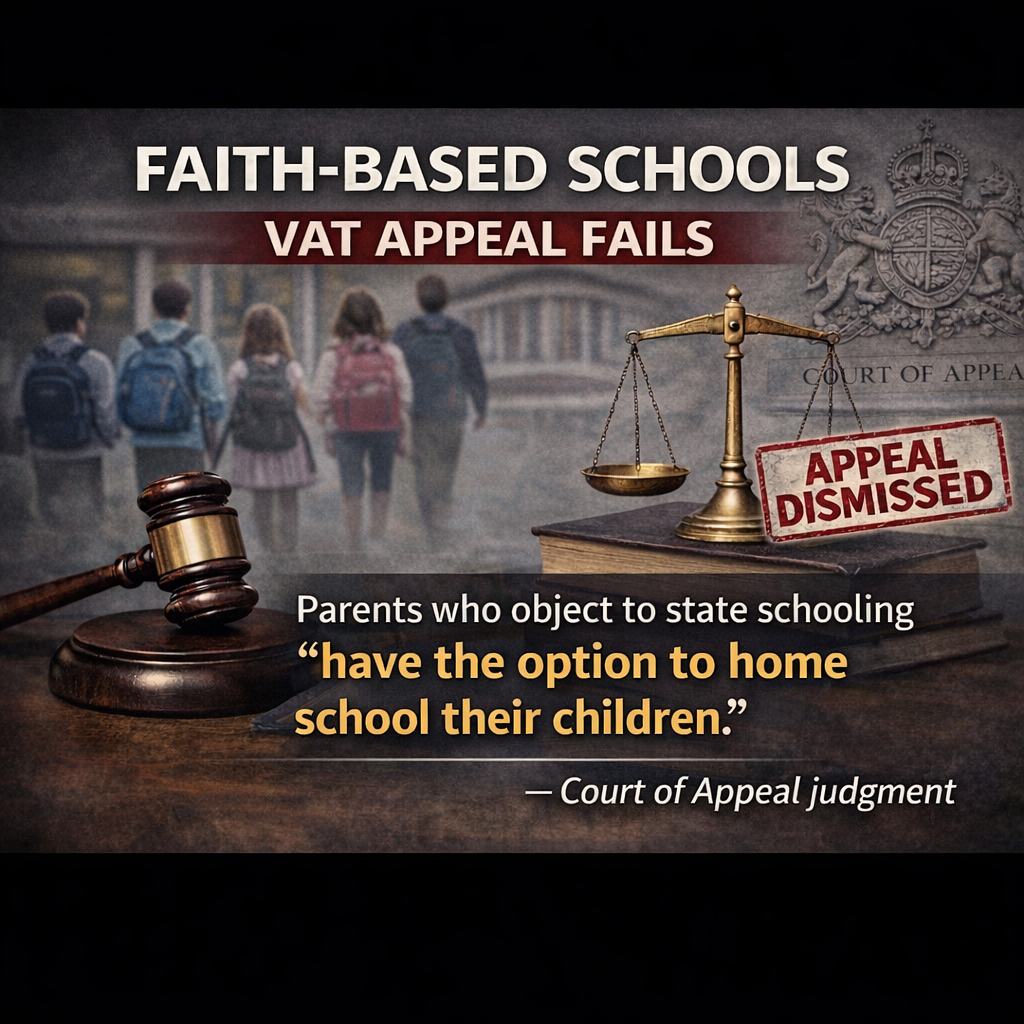
- The judges noted that parents who object to state schooling retain the option of home education.
- The case raises wider questions about parental choice in education and the role of faith-based schools within the education system.
Featured Quote
“For many families, faith-based schooling is not simply a preference but a reflection of deeply held convictions about how their children should be educated. The wider debate about how public policy affects parental choice in education is likely to continue.”
— Michelle Daniells, CEO, Association for Families of Independent Schools (AFIS) C.I.C.
Full Article
On 20–22 January 2026 the Court of Appeal heard an appeal brought by groups representing lower-cost, faith-based independent schools. The Court’s decision, dismissing the appeal, was published on 27 February 2026.
The claimants, representing Christian and Jewish schools, argued that the type of religious education sought by some parents for their children is not available within the state system. They contended that the imposition of VAT on independent school fees would make many faith-based schools unaffordable for families, potentially forcing pupils to leave and threatening the financial viability of certain schools.
Many of the schools concerned charge relatively modest fees and in some cases rely on additional community support and donations. The claimants argued that applying VAT to school fees would deprive many children of access to the specialist religious education their parents seek. They therefore maintained that the policy was discriminatory and incompatible with three provisions of the European Convention on Human Rights (ECHR).
In defending its position, the Government argued that treating religious schools differently – for example by introducing a fee threshold below which VAT would not apply – would raise several significant issues including fairness between schools, market distortion, enforcement challenges for HMRC and reduced tax revenues.
In a detailed judgment, the Court of Appeal broadly rejected the claimants’ arguments, concluding that although the policy could engage certain rights under the European Convention on Human Rights, any interference was justified and proportionate in pursuit of the Government’s legitimate policy objectives.
Michelle Daniells, CEO of AFIS, commented that the case highlights an important and often sensitive issue around parental choice in education, noting that for many families faith-based schooling reflects deeply held convictions about how their children should be educated and the values that should shape their upbringing.
She also noted that while the Court observed that parents may choose home education if they object to state schooling, in practice this is not a realistic option for many families, underlining the importance of maintaining a diverse range of educational choices.
The claimants have indicated that they intend to continue their legal challenge by seeking to pursue the matter further through the courts. Looking ahead, the wider debate may extend
beyond the immediate issue of VAT on school fees to broader questions about parental choice and the role of faith-based schooling within the education system.
About AFIS
The Association for Families of Independent Schools (AFIS) C.I.C. is a not-for-profit organisation championing parental choice and advocating for fairer representation for families who choose independent schooling.