New evidence suggests growing pressure on state school access, as rising costs in the independent sector drive demand and expose gaps in how capacity is measured
Families across England are increasingly struggling to secure suitable state school places, as rising costs in the independent sector and VAT on school fees push more children into the system and intensify competition in key areas.
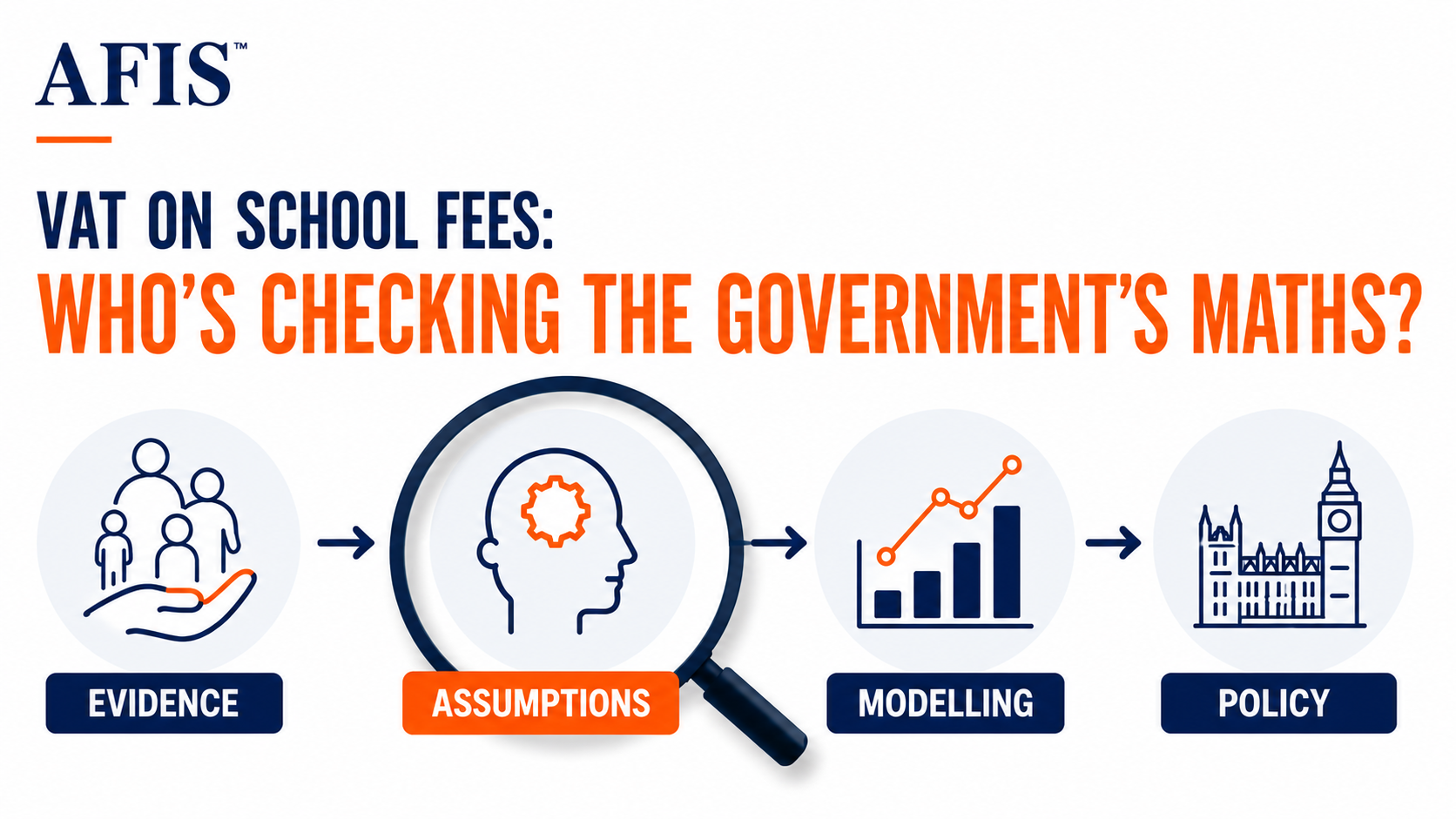
At AFIS, we have been monitoring this closely and raising concerns with Government.
In early March, we wrote to the Secretary of State for Education, Bridget Phillipson, warning that the timing and cumulative impact of VAT and other cost pressures risked disrupting children’s education and increasing pressure on state provision.
In response, the Department for Education stated that it had seen “no excessive pressure on the state-funded system” and that no local authority had reported difficulties in offering suitable places to children moving from private schools as a result of VAT.
The Department also pointed to school census data from June 2025, showing that private school pupil numbers remain within long-term historical patterns
BUT……..
The school census data cited by the Department reflects a snapshot from June 2025, just months after VAT was introduced and business rates relief was removed from charitable independent schools. This is before many families had reached key decision points and been forced to leave their independent schools. At that stage, a significant number were taking steps to avoid disrupting their children’s education, absorbing costs or delaying decisions where possible. As a result, the data does not capture the cumulative impact now emerging through the 2025–26 academic cycle, particularly in applications for September 2026.
Many families have done everything possible to avoid disrupting their children’s education, particularly those with children approaching GCSEs or A-levels. As a result, decisions are delayed until natural transition points.
Early evidence from Scotland suggests a similar pattern, with declines in independent school enrolment concentrated at entry points rather than mid-cycle, reinforcing the view that families delay decisions to minimise disruption.
What families are experiencing
We are hearing from a growing number of families who are being told that local schools are full or heavily oversubscribed.
In some cases, children are unable to secure suitable places at all.
One parent told us:
“We have to take our daughter out because of the increase in the school bill. She is super stressed as we do not have a place to go because everything is over-subscribed. She has been crying a lot. I am angry, sad and frustrated.”
In another case, a family reported enrolling their child in a school abroad after being unable to find a suitable place locally.
One mother, who had been planning, for a long time, to send her youngest son to follow his elder brother into their local independent school has had to abandon those plans due to VAT and fee increases, meaning separate schools, challenging school runs and a mismatch in the quality of schooling being received by her two children.
All this is detrimental to the parental choice that AFIS is working hard to champion.
This is affecting all families, not just those leaving independent schools
This is not just an issue for families moving out of independent education.
We are also hearing from state school families who are experiencing:
- increased competition for places
- rising entry thresholds at high-performing schools
- larger class sizes and growing pressure on resources
Families who might previously have expected to secure places at local grammar schools or high-performing state schools are now finding that their children are missing out. They are not happy either.
Hidden demand is increasing pressure on the system
Not all of this movement is visible in official data.
Many families who had planned to send their children to independent schools are now unable to afford to do so. Some are delaying entry; others are abandoning plans altogether.
These children are not recorded as “leaving” the independent sector, but they still increase demand for state school places.
Why this pressure is not being captured in official data
One of the most important factors is how the system is measured.
Post-16 provision—including school sixth forms and further education colleges—sits outside the statutory admissions system.
This means:
- providers manage their own admissions
- application and refusal data is not collected centrally
- local authorities have no oversight of capacity
As a result, one of the areas where demand appears to be rising fastest is effectively invisible in official statistics.
This hidden demand means the true impact on the system is likely being underestimated.
Timing is creating “no-win” situations for families
The timing of these changes is a major factor.
Education operates on fixed academic cycles, with key decisions tied to admissions deadlines and notice periods.
Families are now being forced to make decisions after key admissions deadlines have passed, leaving them reliant on waiting lists and late allocations.
In some cases, families are being told they may not know until late August whether a place will become available, leaving no time to plan for September.
This creates what many describe as a “no-win” situation, where parents have had to decide whether to give notice to their current school without any guarantee of securing an alternative.
A problem concentrated in London and the South East
This pressure is not evenly distributed.
Our analysis suggests it is concentrated in London and the South East, where:
- independent school participation is highest
- demand for high-performing state provision is strongest
Recent independent school closures in these areas are adding further pressure, creating sudden and unplanned demand in an already constrained system.
Even relatively small shifts in pupil movement can have a disproportionate impact locally, creating bottlenecks even where national capacity appears sufficient.
Early signs at post-16 level
We are already seeing clear signs of pressure at post-16 transition points.
Reports from this year’s admissions cycle include:
- record application volumes
- students meeting entry criteria but not securing places, that would previously expect to
- catchment areas shrinking
Our initial research in Hampshire and Surrey shows this has been observed at high-performing providers who have experienced record numbers of applications. including:
- Peter Symonds College
- Barton Peveril College
- Esher Sixth Form College
- Farnborough Sixth Form College
- Godalming College
These patterns highlight a structural pressure point, where demand is concentrated and capacity is least flexible.
A cumulative impact, not a single policy
The pressures we are seeing are not the result of a single change, but the cumulative effect of multiple policies introduced in quick succession, including:
- VAT on school fees
- removal of business rates relief
- rising employment costs (especially on the teachers' pension scheme).
Together, these have created a sudden financial shock for many families.
Because education decisions ate usually made over long timeframes, this has disrupted plans mid-journey for many children.
In our view, these pressures were foreseeable and could have been mitigated through a more gradual, phased implementation aligned to academic cycles.
What needs to happen next
We are calling on the Department for Education to:
- provide greater transparency on how school place capacity is assessed locally
- improve visibility of demand at key transition points, particularly post-16
- assess whether provision is sufficient in high-demand areas
- ensure future policy changes are better aligned with academic cycles
A growing gap between policy and reality
The Government’s position is based on national-level data.
But families do not experience the system at a national level.
They are trying to find a place:
- in a specific location
- at a specific moment
- for a specific child
There may be enough places in total—but not where and when families need them.
This is happening now
For families, this is not a theoretical issue.
It is already affecting:
- access to suitable school places
- educational continuity
- children’s wellbeing
As we continue to gather evidence, one thing is clear:
👉 The pressure is real. And it is growing. And its children who are paying the price
Please share your stories of problems securing state school places:
Email: michelle@afis.org.uk
(Confidentiality is assured)