On 3 March 2026, AFIS CEO, Michelle Daniells, wrote to the Education Secretary, Bridget Phillipson, to request the creation of a time limited Independent Education Hardship Support fund to protect children from mid-cycle disruption and reduce unplanned pressure on the state sector.
The letter highlighted the challenges created by the timing and scale of the policy changes, which took effect part-way through the academic cycle. Parents will be familiar with the education cycle which operates on fixed timetables involving examination years, notice periods, and limited school capacity in many areas, meaning families could not adjust their children’s schooling at short notice.
The response from the Department for Education stated that ‘overall, private school pupil numbers remain within historical patterns seen for over 20 years’, that they had seen ‘no excessive pressure on the state-funded system’ and ‘no local authority had suggested they were struggling to offer suitable school places to children moving from private schools as a result of the VAT being charged on fees’.
The reply has raised new questions of the Department for Education’s approach and data references that AFIS believe need to be clarified. In our response which you can read in full below, we are asking for the Department for Education to confirm:
- The mechanism by which local authorities are reporting capacity pressures;
- The time period covered by this assessment;
- Whether this includes post-16 provision; and
- Whether it captures forward-looking indicators such as applications and admissions.
We are asking for greater transparency of the Department’s underlying data. In particular, we are looking at the information the department holds on:
- Application, offer, and acceptance rates for post-16 providers over recent years;
- Application volumes and admission thresholds for selective (grammar) schools;
- Any regional variation in demand that may indicate emerging capacity pressures.
We seek clarification on what assessment the Department has made of post-16 capacity in light of anticipated pupil movement, and what steps, if any, have been taken to expand provision. In particular:
- What additional funding has been directed toward post-16 capacity;
- Whether this has resulted in increased places and staffing;
- Any available data on teacher recruitment or resource allocation linked to this policy.
We ask for proportionate mitigation of consequences arising from the timing and implementation of the Government’s policy, many of which were foreseeable given the structure and constraints of the education system.
AFIS sees this as an issue of educational continuity. Policy decisions were taken at system level, but their consequences are being experienced at the level of the child. It is in that context that we again urge the Department to reconsider the need for transitional support.
AFIS reply in full to the Department for Educations email 23 March 2026
Re: Department for Education Response – Transitional Hardship Support
Thank you for your reply of 23 March in response to our letter of 3 March regarding transitional hardship support.
We note the Department’s position and its emphasis on parental choice, public finances, and investment in the state sector. However, your response does not engage with the central issue raised in our correspondence: the timing and implementation of policy change and its immediate, real-world impact on children currently in the independent sector.
As outlined in our original letter, the introduction of VAT part-way through the academic cycle, combined with its scale, has created a structural mismatch between fiscal policy and educational realities. Families are operating within fixed systems defined by school calendars, contractual notice periods, examination timelines, and the availability of alternative provision. This is already resulting in constrained decision-making and, in some cases, disruption to children’s education.
We note that, at the time of policy development, the Government’s own impact assessment anticipated that tens of thousands of pupils (approximately 37,000 over time) may move from the independent sector into state-funded education as a result of this policy. In that context, it would be helpful to understand how the Department reconciles those forecasts with the current position that there is no evidence of pressure on places.
Your response states that pupil numbers remain within historical patterns and that no local authority has indicated difficulty in offering suitable school places. We would be grateful if you could clarify the evidential basis for this assertion, including:
- The mechanism by which local authorities are reporting capacity pressures;
- The time period covered by this assessment;
- Whether this includes post-16 provision; and
- Whether it captures forward-looking indicators such as applications and admissions.
The Department’s position appears to rely on the existence of overall capacity within the state-funded system. However, it is not clear that this has been demonstrated at the level at which families experience the system. Capacity is geographically fixed, varies by phase and type of provision, and is often most constrained at points of transition. The presence of aggregate spare capacity does not necessarily translate into accessible places for individual children in the locations and settings where they are required.
We would therefore welcome clarification as to whether the Department has undertaken analysis aligning areas of independent school enrolment with local state school capacity, including at key transition points such as Year 7 and Year 12.
We also note that wider demographic trends are often cited in support of system capacity. While falling birth rates are beginning to reduce demand in early years and primary provision, this effect has not yet materially reached post-16 education. Sixth form provision is therefore, in many areas, still operating at or near peak demand. This is significant, as pressures arising from increased movement between sectors are most likely to emerge first at these transition points.
By way of illustration, AFIS has undertaken initial, small-scale research in Hampshire which suggests a developing pattern not yet visible in national datasets. At one independent senior school in Portsmouth, families have historically planned for their children to complete GCSEs before progressing to state sixth form provision, most commonly Peter Symonds College in Winchester, which had traditionally accommodated pupils moving from this school.
This year, however, a number of Year 11 pupils were not offered places due to oversubscription, with indications that the effective geographic catchment area has contracted. Families report that pupils living in postcodes that would previously have secured places have not been offered admission in this cycle. Similar reports have been received in relation to Godalming College.
We have also received reports from families in Surrey of increased competition for selective school places. Children who, based on prior attainment, would reasonably have expected to secure places at grammar schools have not done so this year, with families reporting higher effective entry thresholds and a noticeable increase in applications.
While we recognise that admissions outcomes are influenced by multiple factors, these examples are consistent with a system experiencing increased demand at key transition points, particularly post-16 and selective entry, where capacity constraints typically emerge first.
We would also draw your attention to sector data indicating that, in 2025, 5,617 pupils were displaced due to independent school closures; the highest figure in over a decade. This coincides with a marked increase in the number of school closures, including institutions of a scale not typically associated with closure risk. For affected children, particularly those with SEND or those in examination years, such disruption is significant and immediate.
Taken together, these indicators suggest that system pressures may be emerging in ways not yet captured in national-level reporting.
In this context, we would welcome greater transparency regarding the Department’s underlying data. In particular, we would be grateful for information on:
- Application, offer, and acceptance rates for post-16 providers over recent years;
- Application volumes and admission thresholds for selective (grammar) schools;
- Any regional variation in demand that may indicate emerging capacity pressures.
We would also welcome clarification on what assessment the Department has made of post-16 capacity in light of anticipated pupil movement, and what steps, if any, have been taken to expand provision. In particular:
- What additional funding has been directed toward post-16 capacity;
- Whether this has resulted in increased places and staffing;
- Any available data on teacher recruitment or resource allocation linked to this policy.
If such information is not readily available, AFIS is considering submitting a formal request under the Freedom of Information Act to better understand these trends.
We also note the Department’s reference to the “94% of children” educated in the state sector. We would be grateful for clarification as to how this figure has been calculated, including whether it reflects a current snapshot of school attendance or a broader population estimate, and how mixed educational pathways are treated within this figure.
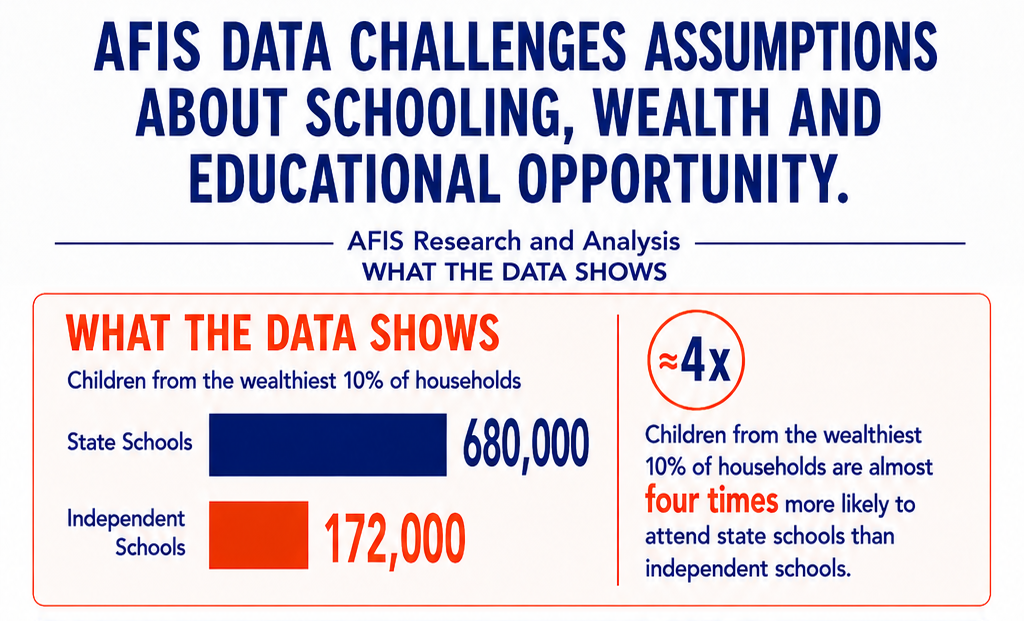
More broadly, we would welcome clarification on how the Department assesses the distributional impact of this policy. While it is often framed in terms of supporting the majority of pupils in the state sector, it is important to recognise that socioeconomic advantage is not confined to one sector. Given the scale of the state system, a substantial proportion of children from more affluent backgrounds are educated within it in absolute terms.
This raises an important question as to whether sector-based policy measures are effectively targeted at disadvantage, or whether they risk operating as broad interventions that do not directly align with the underlying drivers of inequality.
It is also important to recognise that the financial pressures currently affecting independent schools arise from multiple factors taking effect within a compressed timeframe. The introduction of VAT on school fees, the removal of business rates relief for charitable independent schools, increased employer contributions associated with teacher pension provision, and wider inflationary cost pressures have combined to create a significant and immediate shift in the cost base of many schools.
While each of these factors may be considered individually, their cumulative impact, particularly when implemented over a short period, has materially reduced the capacity of many schools to absorb additional costs without passing them on to families.
We note the suggestion that schools may absorb VAT costs to mitigate fee increases. In practice, this is not consistently borne out across the sector. While some schools may be able to offset a portion of VAT through cost management or input VAT recovery, this must be considered alongside the cumulative impact of concurrent policy changes.
In particular, the removal of business rates relief has introduced a significant additional cost burden. It is also important to recognise that the independent sector is not financially homogeneous. While a small number of larger institutions may have access to substantial reserves or diversified income streams, many schools, particularly smaller and medium-sized institutions and faith schools, operate on comparatively modest margins and are heavily reliant on fee income. For these schools, the capacity to absorb significant, structural cost increases is inherently limited.
Taken together, these factors mean that the suggestion that schools can broadly mitigate or absorb these changes without significant pass-through to families does not reflect the financial realities being reported across the sector.
We note that independent schools are at times characterised as “businesses” in the context of these policy changes. We would welcome clarification as to how this categorisation is being applied for policy purposes, particularly given that many independent schools operate as registered charities.
While such schools charge fees, this is not unique within the charitable sector, where a range of organisations provide services on a fee-paying basis while retaining charitable status. In this context, it would be helpful to understand the basis on which independent schools have been treated differently from other charitable organisations in respect of fiscal policy, including the removal of business rates relief, and how this aligns with the Government’s broader approach to charities delivering public benefit.
The Government recognises that many parents work hard and save hard to fund independent education. It is therefore important to acknowledge that these families are already contributing fully to the state system through taxation while not drawing upon it. The current policy, as implemented, places an additional and immediate burden on those same families, without transitional protection for their children’s education.
This is not an argument against the Government’s fiscal objectives. As stated previously, AFIS is not seeking reversal of policy. Rather, we are asking for proportionate mitigation of consequences arising from the timing and implementation of that policy, many of which were foreseeable given the structure and constraints of the education system.
Our request remains focused and practical:
A time-limited, targeted hardship support mechanism to protect children at risk of mid-cycle disruption, particularly those in examination years and specialist or SEND provision.
Such a measure would:
- Prevent avoidable disruption to children’s education;
- Reduce reactive pressure on the state sector;
- Allow policy reform to proceed without unintended harm during transition.
We would welcome the opportunity to meet with officials to share anonymised case evidence and modelling, and to discuss how a targeted transitional scheme could be implemented in a timely and practical manner. Given the proximity of key notice deadlines within the academic cycle, we would be grateful for a response within the coming weeks.
This remains, at its core, an issue of educational continuity. Policy decisions may be taken at system level, but their consequences are experienced at the level of the child. It is in that context that we urge the Department to reconsider the need for transitional support.
Yours sincerely,
Michelle Daniells
CEO & Founder
AFIS