Click HERE to engage with AFIS on Linkedin
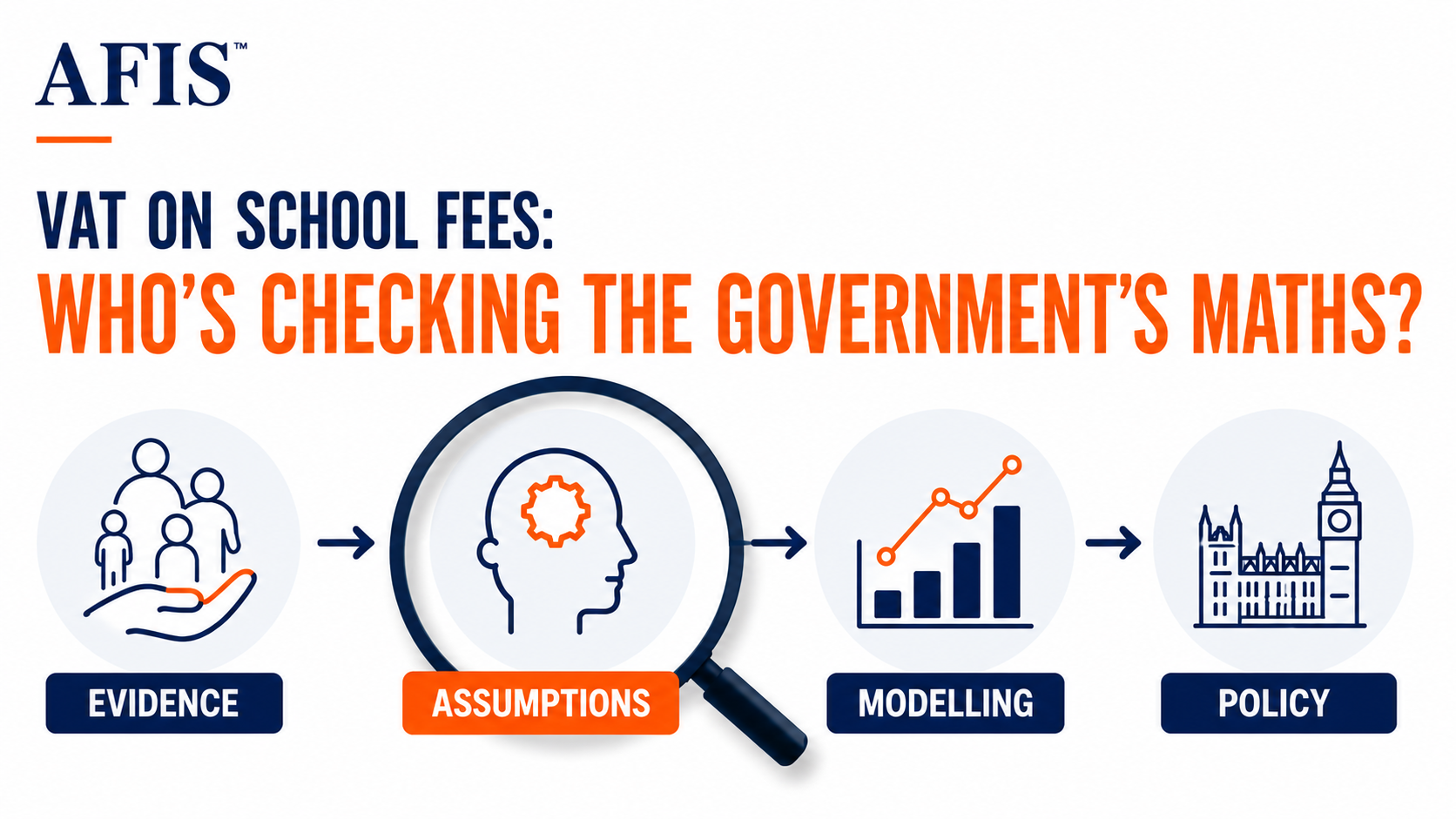
An examination of recent Wealth Index findings and what they reveal — and overlook — about the full range of families affected by VAT on independent school fees.
Public debate about independent schools often begins with familiar imagery: children in straw boaters, shorthand for privilege and wealth. That framing is persistent, but it risks obscuring a more complex and less visible reality.
A recent article in The Times, reporting on findings from the Saltus Wealth Index, has added fresh data to the discussion around the impact of VAT on independent school fees. The headline figures are striking and have understandably prompted wider commentary.
However, before those figures are taken as representative of the sector as a whole, it is important to examine what the underlying research can — and cannot — tell us.
The Saltus survey questioned 1,167 parents with children in independent schools as part of a broader study of high-net-worth individuals. Participants were defined, by Saltus’s own criteria, as parents holding investable assets of at least £250,000. This is a clearly delineated group: financially secure households with a degree of resilience not shared across the entire independent school parent population.
That distinction matters.
Research of this kind can offer useful insight into how higher-net-worth families are responding to rising costs. But it does not follow that those findings can be generalised to all families with children in independent education. The question, therefore, is not whether the data is interesting — it is whether it is representative.
Even within this affluent cohort, the findings are notable. Around one in five respondents report having already moved their child from their current private school, with a further 10% expecting to do so in the future. These figures are often interpreted as evidence of pressure within the sector.
They should also be understood as something else.
When some of the most financially resilient families in the system are making changes to their children’s schooling, this is not a marginal signal. It suggests that rising costs are having tangible effects even among those best placed to absorb them.
Set against the broader context, the limits of the dataset become clearer. Estimates suggest there may be around 360,000 families with children in independent schools in the UK. If so, a sample of 1,167 represents approximately 0.3% of that population.
But the more significant issue is not size alone. In survey research, relatively small samples can still produce reliable insights if they are representative. The more fundamental limitation here is the sampling frame itself.
By design, the Saltus survey captures only a particular segment of the population: families with substantial investable assets. It does not include the many households who do not meet that threshold but who nonetheless choose independent education for their children.
These families are largely absent from wealth-based analyses.
Yet they are a significant part of the independent school community. They include households who make careful financial decisions over many years: reducing discretionary spending, adjusting lifestyle choices, and prioritising education within constrained budgets. For these families, the financial calculus is very different.
A substantial increase in fees — such as that resulting from the introduction of VAT on independent school education — is unlikely to prompt a gradual rebalancing of long-term financial plans. Instead, it can force immediate and sometimes irreversible decisions about whether independent schooling remains viable.
This distinction is important when interpreting the Saltus findings.
The survey also reports that 71% of high-net-worth parents who remain in the sector say they have already made, or expect to make, financial sacrifices to sustain their children’s education. These include measures such as taking on debt or restructuring housing arrangements.
These are families with at least £250,000 in investable assets.
If households with that level of financial resilience are adjusting their financial behaviour in response to rising fees, it is reasonable to ask how the same pressures are being experienced by families without comparable resources.
At present, there is limited systematic data to answer that question.
This is the central challenge in the current debate. Public discussion is being shaped, in part, by data drawn from a specific and relatively affluent subset of families. While valuable, it does not capture the full range of experiences within the sector.
The risk is that policy discussions proceed on the basis of an incomplete picture.
The real question, therefore, is not simply whether wealthier parents are feeling the impact of rising costs. It is what is happening to the many independent school families who do not appear in wealth surveys at all.
Understanding this broader population matters for several reasons. It informs how we think about access to independent education, the diversity of families within the sector, and the potential consequences of policy decisions such as the introduction of VAT on school fees.
Without a clearer evidence base, these discussions risk being shaped by partial or unrepresentative data.
At Association for Families of Independent Schooling, we work closely with families across the independent sector and see first-hand the range of circumstances and motivations that underpin their choices. These experiences do not fit neatly within a single narrative of wealth or privilege.
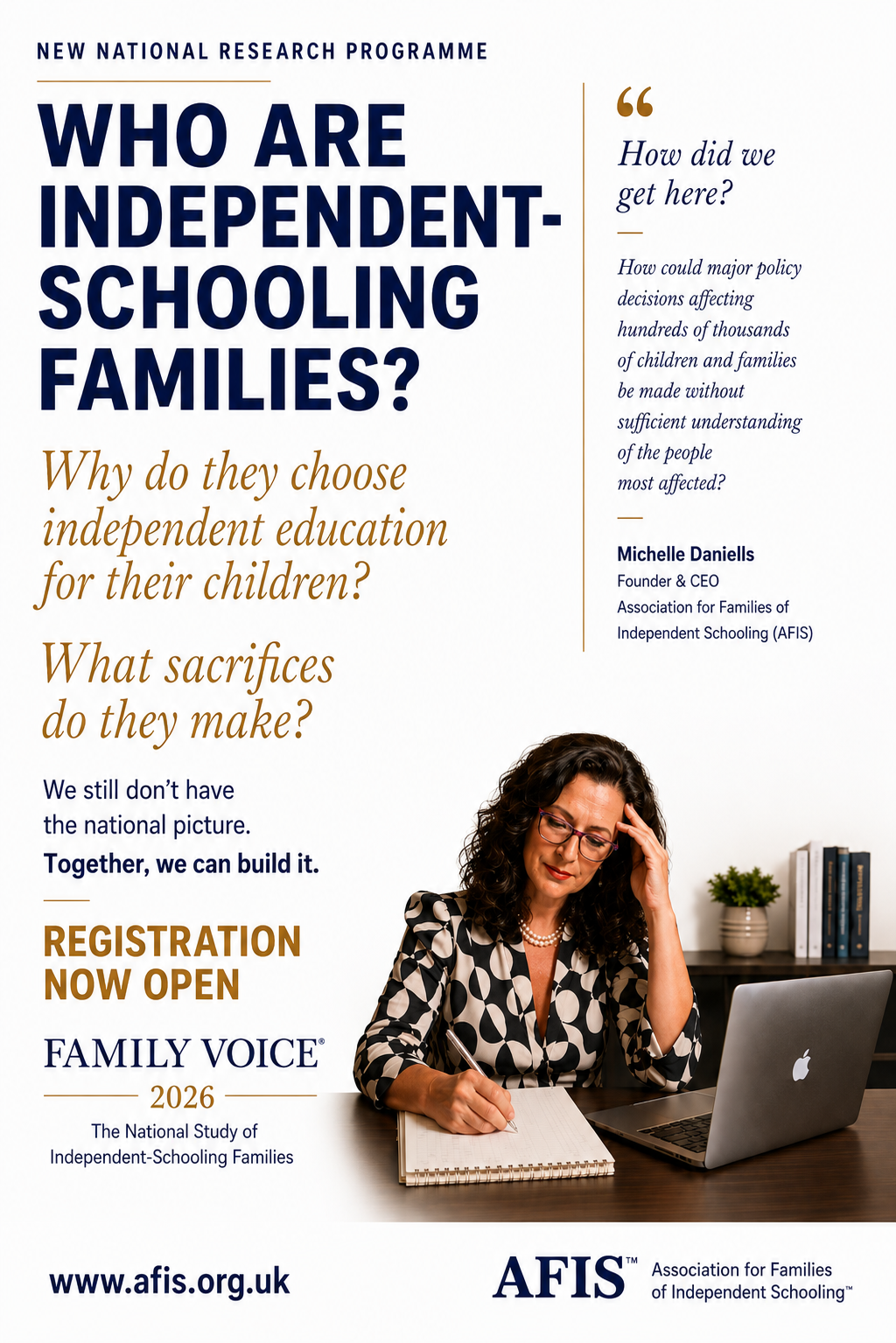
To support a more informed debate, AFIS will soon be commencing a national survey exploring the demographic profile of independent school families and their reasons for choosing independent education.
The aim is to contribute to a more complete understanding of who these families are, how they make decisions, and how they are affected by changes in policy and cost.
Because a meaningful discussion about the future of independent education requires more than headline figures. It requires a clear view of the full breadth of families whose choices shape the sector.
Ensure that your family is represented in this survey. Join AFIS today www.afis.org.uk