Click HERE to engage with AFIS on Linkedin
It’s Time We Reconsider How We Use Them
School type is increasingly used as a shorthand for socio-economic background across policy, public institutions and media coverage. While often well-intentioned, this risks oversimplifying a complex reality.
Sign the petition to end unfair pricing for children based on school type
This article explores how such labels can distort understanding, reinforce stereotypes and shape access to opportunity. It outlines the steps AFIS is taking to promote a more accurate and balanced approach, including a complaint to IPSO and the launch of an Education Pathway Neutrality initiative.
Across policy, public institutions and media coverage, school type, whether state or independent, is increasingly used as a shorthand for socio-economic background.
The intention behind this is understandable. Efforts to widen participation and improve social mobility are both important and necessary. But the growing reliance on school labels as a proxy for disadvantage risks oversimplifying a far more complex reality.
At the Association for Families of Independent Schooling (AFIS), we have spent the past year examining how these assumptions are shaping decisions, narratives and opportunities. What we have found is a consistent and often overlooked pattern: children are increasingly being categorised, and in some cases judged, based not on their individual circumstances, but on the type of school they attend.
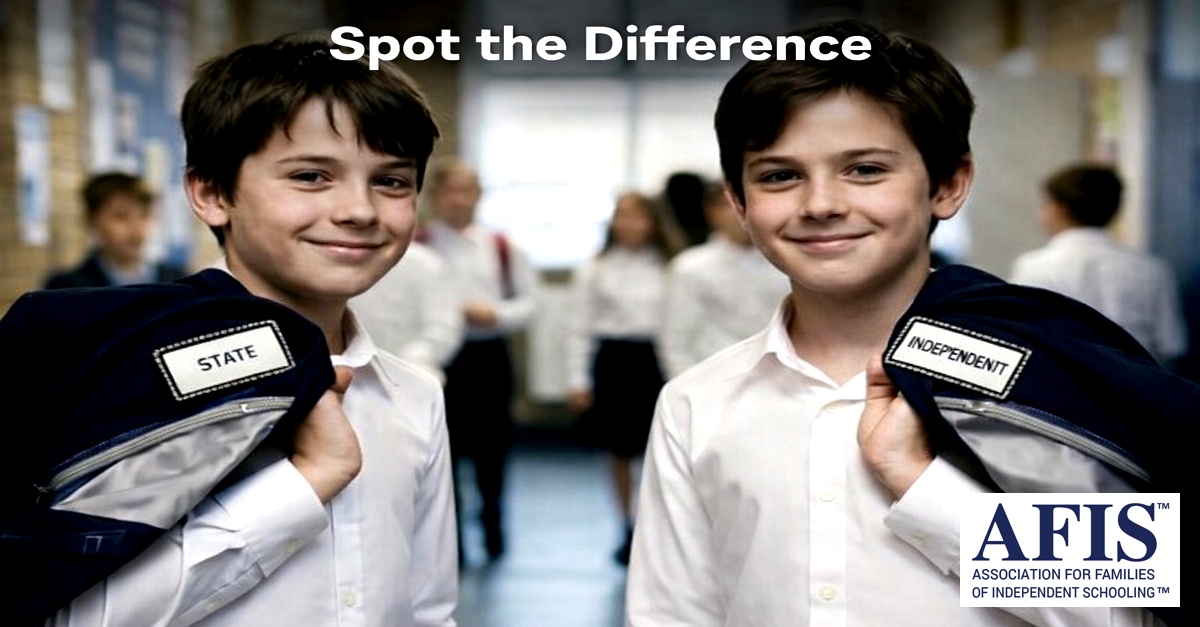
This matters, because school type is not a reliable indicator of family background.
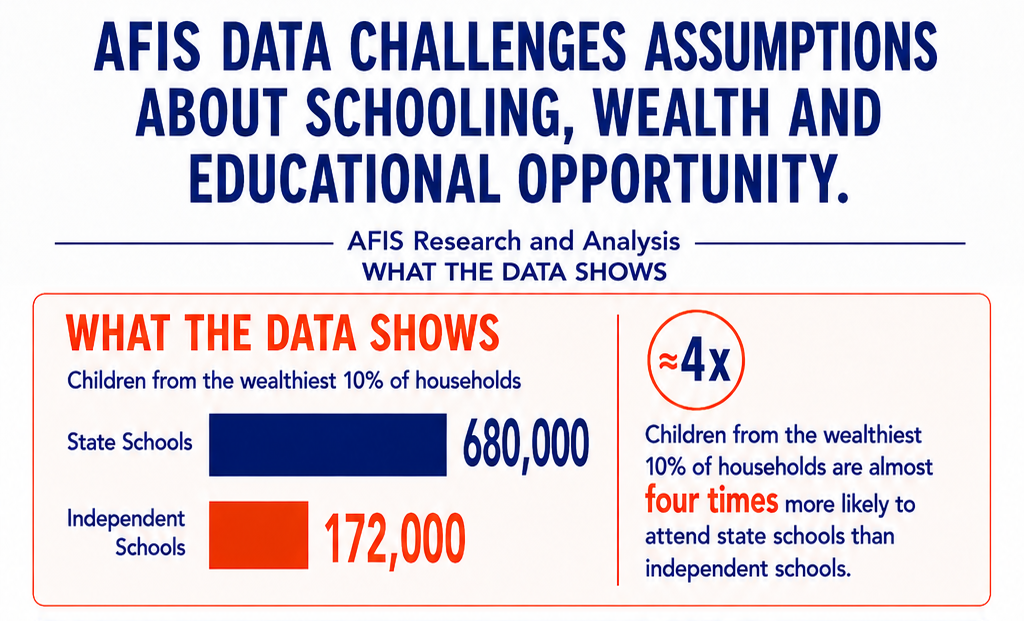
Our analysis indicates that there are around four times as many pupils from the wealthiest households (top income decile) in state schools as there are in independent schools. In fact, the number of pupils from the highest income decile attending state schools alone exceeds the entire independent school population.
This highlights the limitations of using school type as a proxy for socio-economic status.
Family circumstances vary widely across all school types. Yet in many areas of public life, the distinction between “state” and “independent” is treated as if it carries clear and consistent meaning about advantage, opportunity or need.
In reality, it does not.
Sign the petition to end unfair pricing for children based on school type
Where these labels are shaping outcomes
This use of school labels is not confined to one area. It appears across a range of settings, often in well-intentioned efforts to address inequality.
In arts and cultural institutions, differential pricing policies sometimes distinguish between pupils based solely on school type. In access and outreach programmes, eligibility criteria can be defined in ways that prioritise school categories rather than individual circumstances. In some cases, criteria for work experience opportunities are also defined in ways that rely on school type as a proxy.
And in the media, reporting frequently highlights the school attended by individuals, particularly in crime coverage, in ways that can reinforce stereotypes.
(See our previous article about “former private school” labels in crime reporting: AFIS - Association for Families of Independent Schooling | UK Independent Education Support)
'Why are the media so obssessed with calling criminals former public school boys'
Taken together, these patterns contribute to a simplified narrative: that school type can stand in for background.
But this is a very blunt approach to a nuanced issue.
When broad labels are used as proxies, they can lead to unintended consequences. Genuinely disadvantaged pupils may be overlooked if they do not fall within expected categories. Others may be assumed to have benefited from privilege that does not reflect their lived reality. In both cases, the goal of supporting those who most need it is undermined.
The role of media narratives
One of the most visible ways these assumptions are reinforced is through media reporting.
In particular, crime reporting has, at times, included references to the school attended by individuals where this detail is not relevant to the story. These references can contribute to a narrative in which educational background is used to imply character, context or culpability.
These labels can also follow individuals far beyond their time in education. In some cases, media coverage continues to describe individuals by the type of school they attended many decades earlier, where this information has no relevance to the story. The use of terms such as “former private schoolboy” to describe individuals well into later life illustrates how school background can become a lasting label, shaping perception in ways that are disproportionate and potentially misleading.
As part of this work, AFIS has submitted a complaint to the Independent Press Standards Organisation (IPSO).
AFIS’s complaint centres on a pattern of media reporting that risks distorting public understanding of independent schools in three key ways: the use of inconsistent and imprecise terminology (particularly the interchangeable use of “public” and “independent” school), the inclusion of irrelevant educational descriptors in crime reporting that can imply unwarranted associations, and broader patterns of unrepresentative framing, often focused on a narrow group of elite institutions, which together create a misleading picture of a diverse sector.
The complaint argues that these issues engage Clause 1 (Accuracy) of the Editors’ Code of Practice, on the basis that they risk creating a materially misleading impression and reflect a failure to take due care over accuracy in both presentation and context.
This is an initial step aimed at encouraging greater consistency and care in how educational background is represented in public discourse.
A need for greater precision
The common thread across these examples is not intent, but method.
Policies and narratives are often built on proxies, school type, postcode, or institutional category, because they are easy to apply. But ease should not be confused with accuracy.
If the goal is to identify disadvantage, then we need to focus on direct measures of individual circumstance, rather than relying on broad institutional labels.
This is not about removing support or changing the aim of widening participation. On the contrary, it is about making those efforts more effective, more precise, and ultimately fairer.
Education Pathway Neutrality
In response to these findings, AFIS will shortly be launching a new initiative focused on what we call Education Pathway Neutrality.
At its core is a simple principle: children should not be advantaged or disadvantaged simply because of the type of school they attend.
This is not a sector-based argument. It is not about defending one type of school over another. It is about recognising that children’s circumstances are diverse, and that policies and public narratives should reflect that complexity.
We believe there is an opportunity to bring together voices from across the education sector, including school leaders, policymakers, researchers, think tanks and parent organisations, to explore more accurate and effective ways of identifying disadvantage and allocating opportunity.
A more balanced conversation
Public discussion about education often relies on generalisations. Independent school pupils are sometimes assumed to be uniformly privileged, while state school pupils are often assumed to be uniformly disadvantaged.
Neither assumption holds true.
A more balanced conversation would acknowledge the diversity within both sectors and focus on the factors that genuinely shape outcomes: family income, parental education, local context, and individual experience.
By moving beyond simplistic labels, we can support policies that are better targeted and narratives that are more accurate.
Moving forward
The work AFIS is undertaking is intended to contribute constructively to this conversation.
Our complaint to IPSO is one step. Further work will examine how school labels are used across public institutions and how alternative approaches might improve both fairness and effectiveness.
We recognise that many of the policies and practices we are examining are motivated by a genuine desire to improve opportunity. Our aim is to support that goal by encouraging approaches that reflect the full complexity of the education landscape.
If we are serious about improving social mobility and widening participation, then we must also be serious about how we define and identify disadvantage.
School labels alone cannot do that.
And when they are used as a substitute for deeper understanding, they risk doing more harm than good.
Sign the petition to end unfair pricing for children based on school type